I board the Looe valley line, the two fuggy carriages stuffed with hot, pink skinned tourists. All headed for a bucket and spade day at the seaside.
My stop, the Cornish hamlet of Causeland, comes into view through the trees of the wooded valley, as the train snakes slowly down the scenic branch line. My destination, one of Cornwall’s most magnificent megalithic monuments.
Duloe stone circle is thought to date from the early to middle bronze age – approximately 4000 years ago – around 2000 years BCE. Like all Kernow’s megalithic monuments, it is still an alluring enigma and sits just three miles from Causeland station.
The train stops here so rarely I must specifically request it with the conductor, who instructs me to ‘wave the driver down’ upon my return.
With relief I jump off into the fresh air alone. There is a little scrap of platform, with a small concrete shelter. The burbling stream runs alongside, a remnant of the 18th century Looe to Liskeard canal.
Once the train is out of earshot, I find myself in a timeless scene. The fields behind the stream are alight with riotous swathes of fuchsia fireweed. I’m alone with a chorus of birds, whistling and chattering, accompanied by a band of bees, drunk on the wildflowers. There is something magical about having a place to myself. I feel like I’ve stepped through the looking glass to another realm. My own secret garden.
I dally up a narrow lane, lined by old Cornish hedgerows, full of early – summer life. In the cool dappled shade, hogweed dances among the pink campion flowers. Ferns droop and fight with bindweed for space. Foxglove spines set seed, their flowers now just a memory of spring.
I find the path I identified on the map, starting in the valley, rising out of a carpet of meadowsweet
I make my way to a clearing atop the hill between two deep valleys of woodland. Butterflies flit among the drooping grass seed. Taking in the view I can see how this was an important vantage point in ancient times. The hill-tops of Bodmin moor to the North – adorned with the remains of prehistoric societies, the Cornish coast to the south.
I know this is the ridge-top the stone circle sits upon.
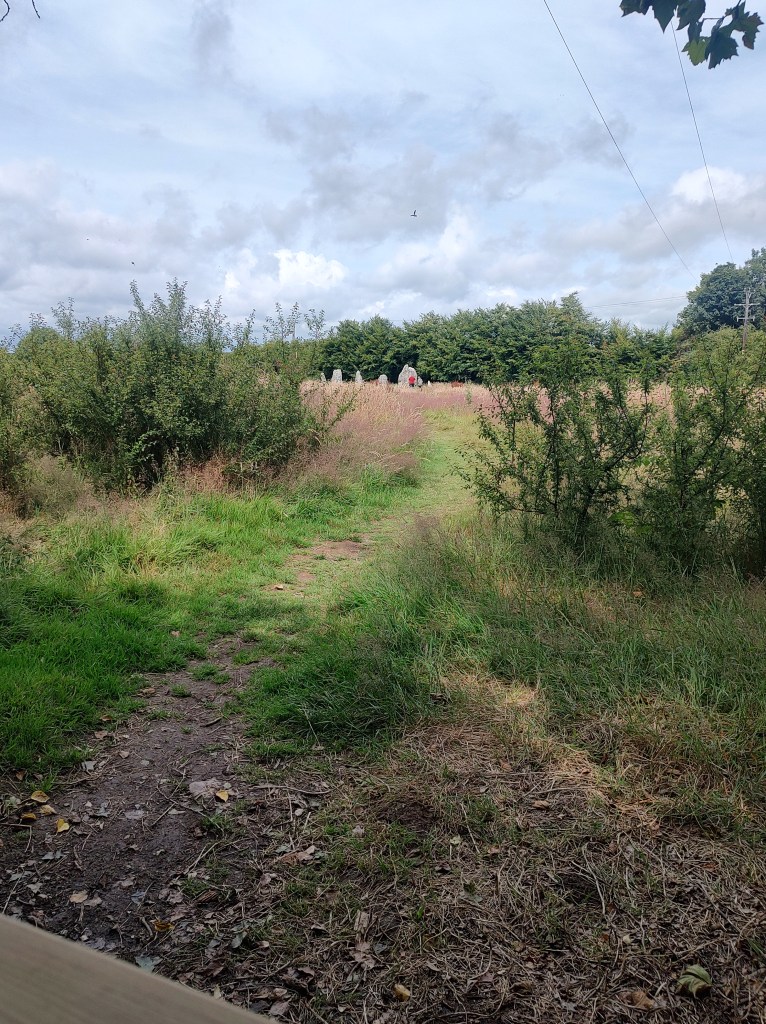
Consulting my map, I choose to rebel against the prescribed right of way. I want to travel as the crow flies, to truly familiarise myself with the landscape the ancient monument belongs to. To travel across country on pilgrimage to a sacred space, like I imagine the bronze-age peoples once did. I have purposefully taken the overland route from the train-stop, avoiding the road, to avoid the trappings of modernity.
I trespass, keeping to the borders of fields. Scrambling over hedgerows, following badger tracks, ducking through barbwire.
I track boot prints into a maize field. Others have been this way. At this point I can hear the stones calling – my internal GPS pulling me.
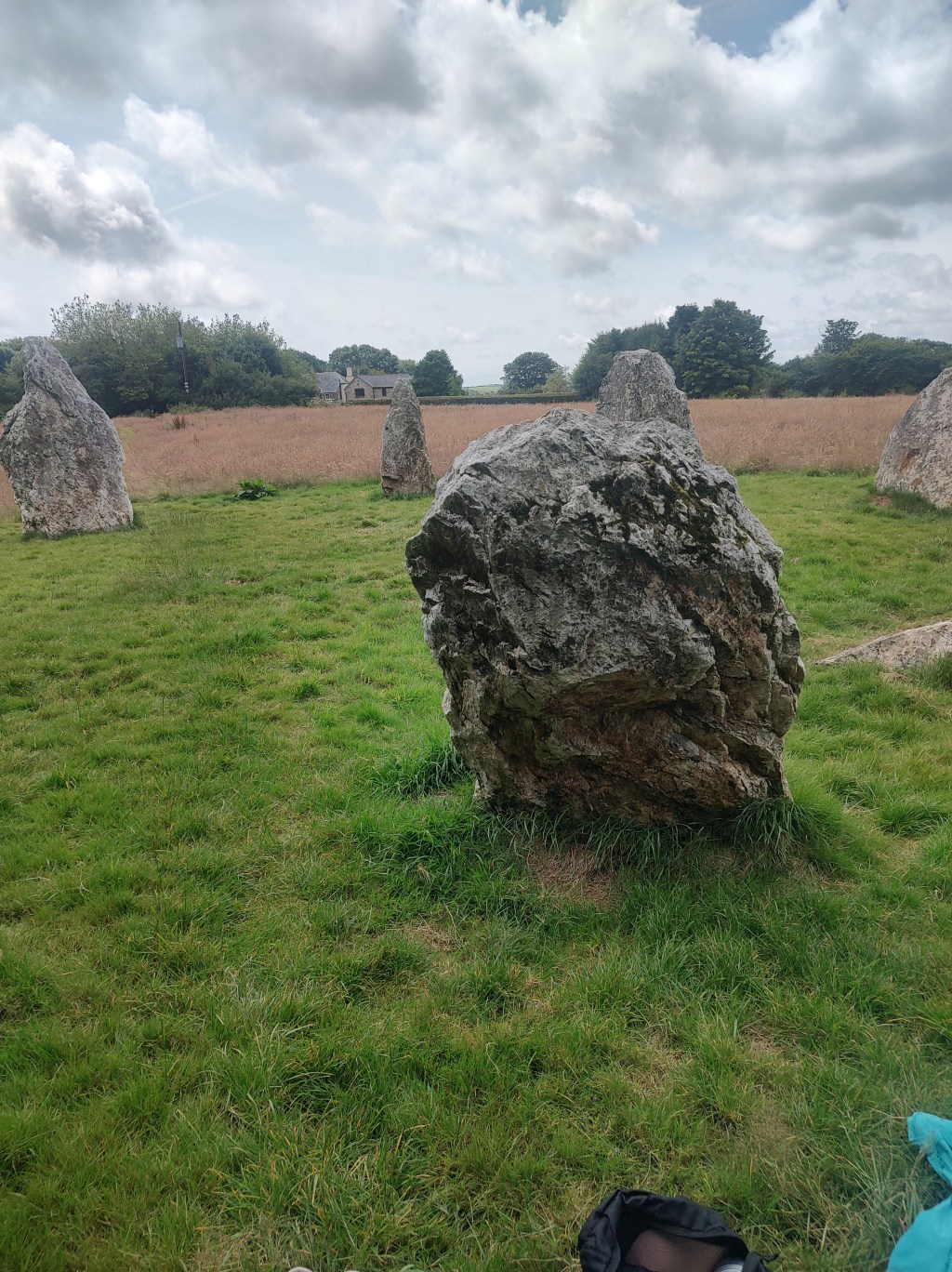
My breath catches as through the hedgerow I glimpse my first sight of the menhirs. I push through the ivy, over the stone wall, into the neighbouring field.
The stone circle stands in the North end. The grass a sea of standing hay, peppered with hogweed, white flowers bobbing in the breeze. Spires of thistle, adorned with purple crowns. Russet docks, heavy with seed, whisper in the breeze.
Swathes of drooping nettles border the field, heavy, bowing under the weight of their seeds. Brown butterflies flit amongst them.
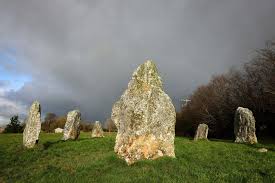
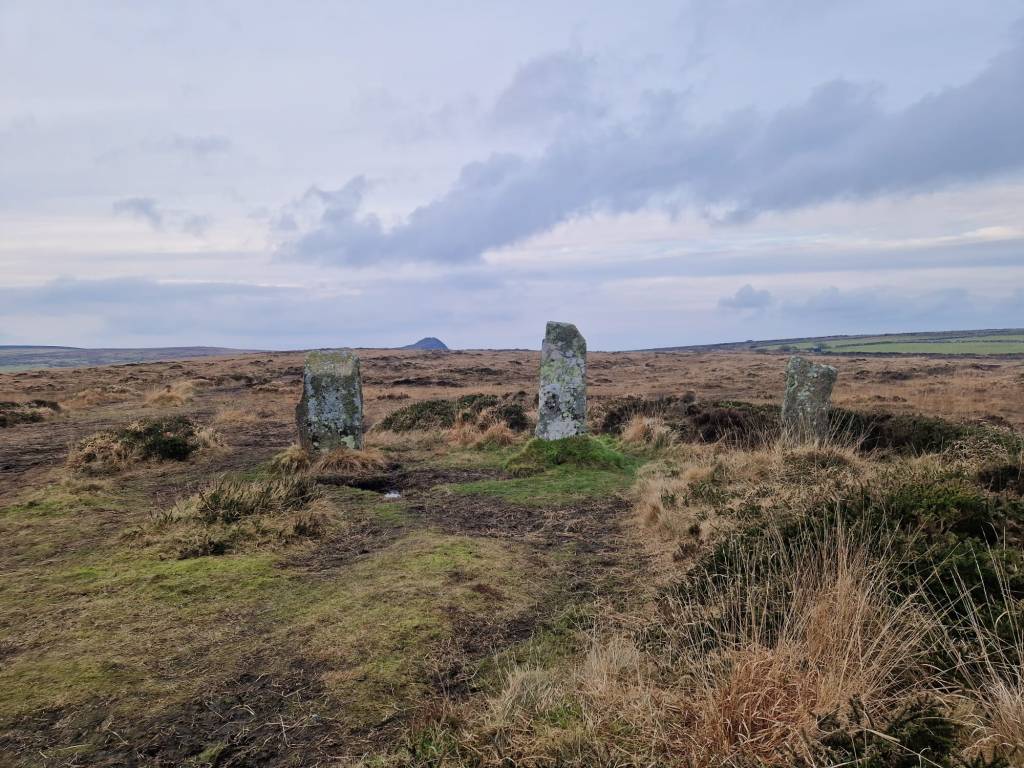
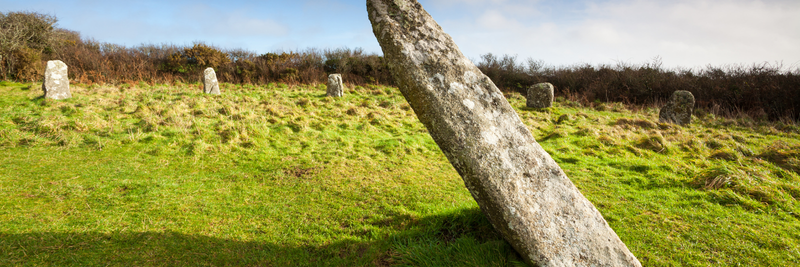
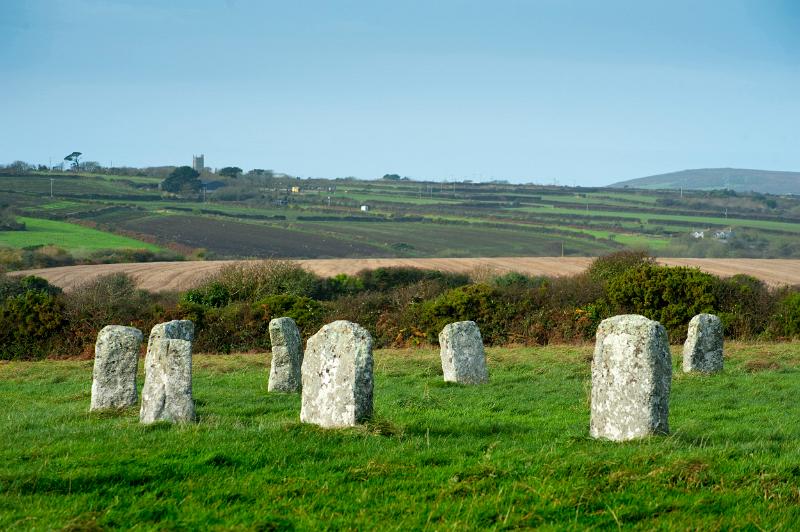
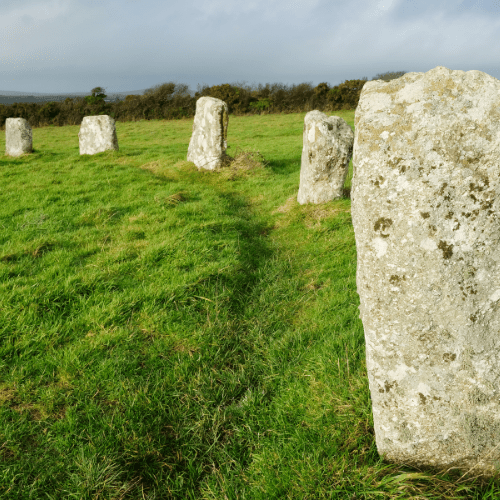
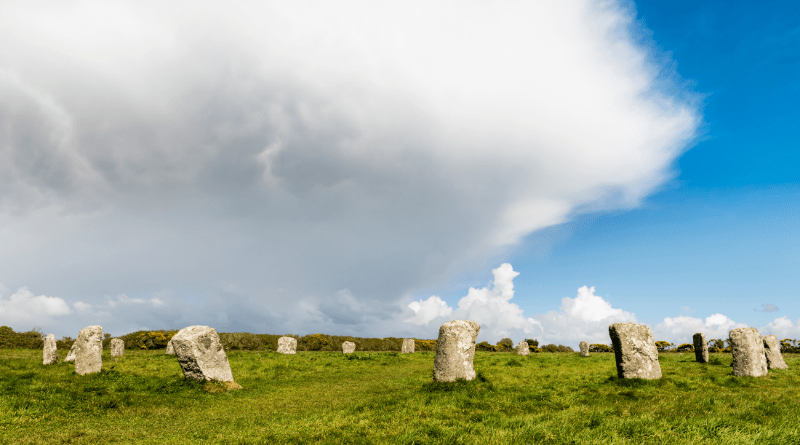
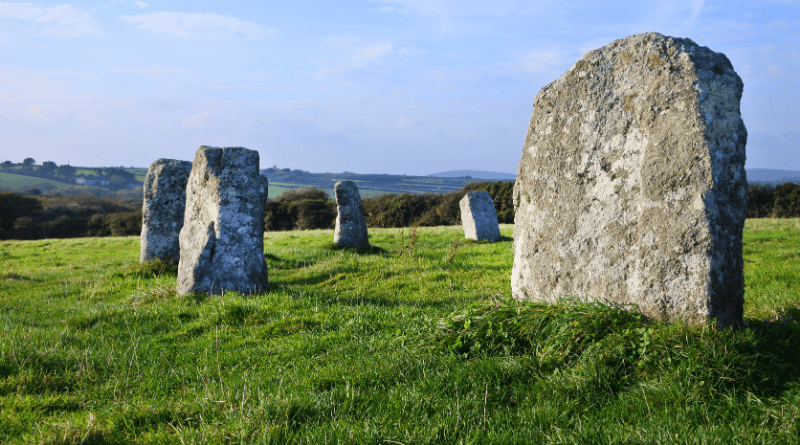
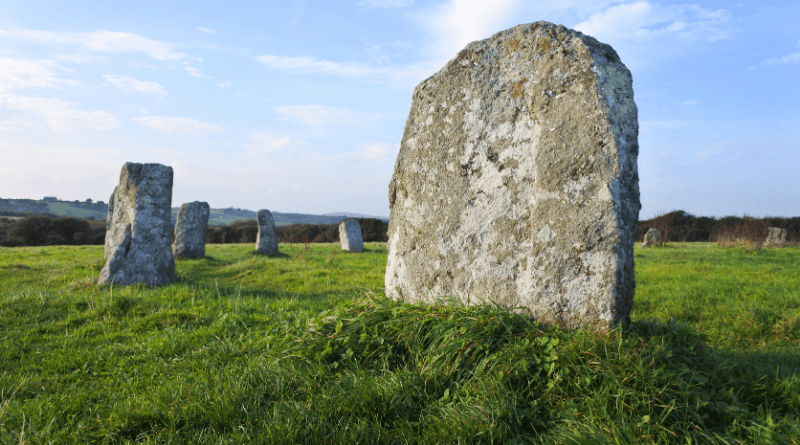
I approach the ring of eight granite, weathered monoliths with a tingle in my sternum. Thick with seams of pearly quartz, dressed in patches of hairy lichens and velvet moss. Hues of pink and grey run through the white rock. The tallest menhir reaches a metre above my head, the smallest shoulder height. Despite being the smallest stone circle in Cornwall, it boasts the grandest, largest stones.
I step into the monument barefoot, the energy palpable, a visceral reaction in my solar plexus. A distinctly feminine energy. I admire the stones, running my fingers over them, exploring like a familiar lover. Enjoying the smoothness of the quartz juxtapositioned with the coarseness of the darker granite.
A feeling of wellbeing, a wave of tingles, like blood returning to a limb, floods my being. My feet connect with the earth energy. I ground myself, taking root in the centre.
Temporally dislocated, I sink back through the millennia.
No doubt the monument had many uses over the millennia, for gatherings, ceremonies, healing and connecting with the spirits of the land. The discovery of a bronze age burial urn inside the circle, supposedly containing cremated human bones, suggests to some a burial site – with the circle possibly built around a cairn.
The four largest stones are set at the cardinal points of North, East, South and West. There is also a potential alignment with late neolithic and bronze age monuments on Bodmin moor to the North. To me this suggests a higher purpose, spiritual work connecting with earth energies and reaching altered states of consciousness. (This is based purely on gut feeling rather than anything resembling archaeological evidence.) It’s possible the urn was buried at this site because of its prior significance.
I imagine how the white quartz menhirs would have shone beatific by day and glowed celestial in the full moon light. A sacred site drawing pilgrims from across bronze age Britain. The hardships and perils they would have faced upon their journey. Called by this stone monument, set high upon the hill rising between the valleys of thick temperate rainforest. Today it continues to be a treasure, a place of worship, for communing with nature and the ancestors. Frequented by megalith enthusiasts, dowsers, geomancers, pagan worshippers, spiritual pilgrims and local dog walkers.
Representing different meanings to different people throughout time. Today, after four millennia it stands as a third space, a refuge, a place of healing and regeneration.
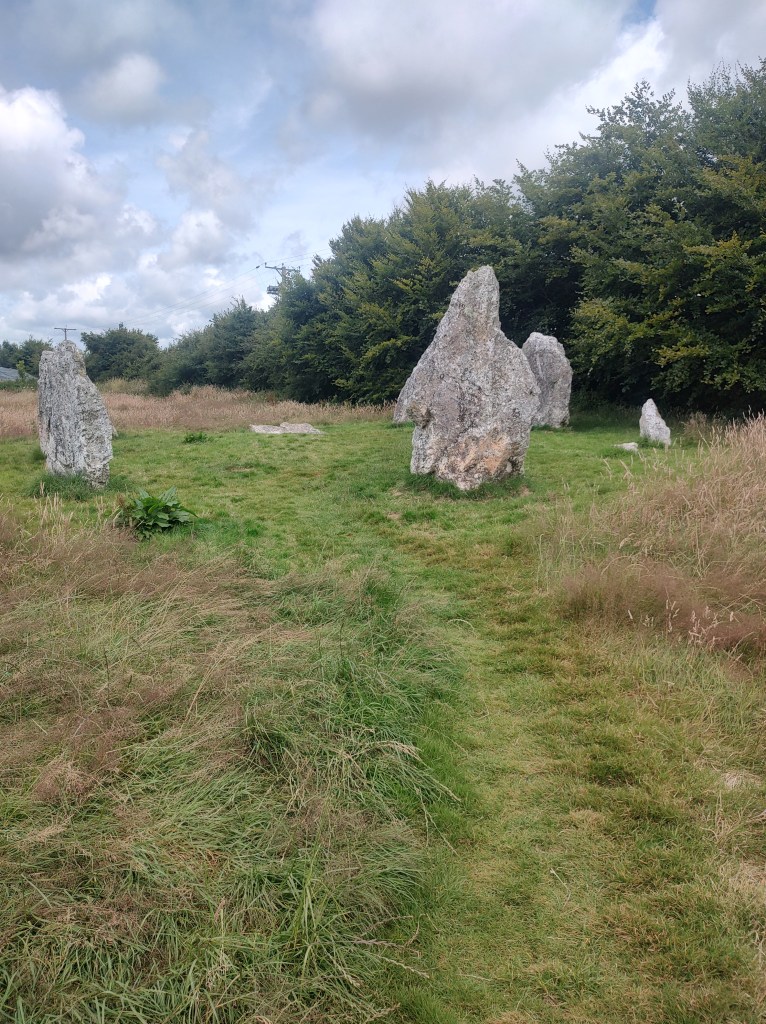
After spending some time with the individual stones, I take myself to the centre to sit and meditate. I sink back to lie upon the welcoming grass. Feeling the breath of the mild breeze upon my face, it wicks the sweat from my brow. The only sound the birdsong and the faint melody of children playing somewhere in the village. The peace is obtrusively broken by the sound of a strimmer starting up in the distant far corner of the large field. I mentally will him to stop and he veers off and takes his strimmer elsewhere. Perhaps subconsciously aware he is not welcome.
Looking up at the wisps of cloud that float across the azure sky I feel a profound sense of connection between heaven and earth.
I close my eyes and start my breathing into my meditation. Calling upon the elemental spirits of the earth below, the air above, the water of the blind springs that I suspect flow deep underneath the impermeable granite rock, and the fire of life that animates us all.
As I lay in the centre, two women arrive at the circle with a curious dog who comes to lie alongside me. As I visualise the healing light rising from the earth, transmitted via the stones the dog reacts, barking until I reach out and place a hand upon him. He settles and continues to lie beside me until I finish my meditation. The owner apologises, but there is no need. I often find dogs are sensitive to the energies that lie within these megalithic monuments.
Today’s profound experience has left a deep imprint upon me. Pleasantly exhausted I opt for the beaten path back to Causeland train station. I venture through the village and descend back into the valley via an endless hot dusty lane. I reach the cool lushness of the flora rich valley with relief and take my place on the platform to await the train back to Liskeard. I hear the old diesel engine chugging through the trees and, as instructed, wave the driver down.
First published in Northern Earth Magazine: Issue 182
Share your experiences with Duloe Stone Circle comment below
Share this post on social media
Follow me on BlueSky
 Uncanny Cornwall Blog
