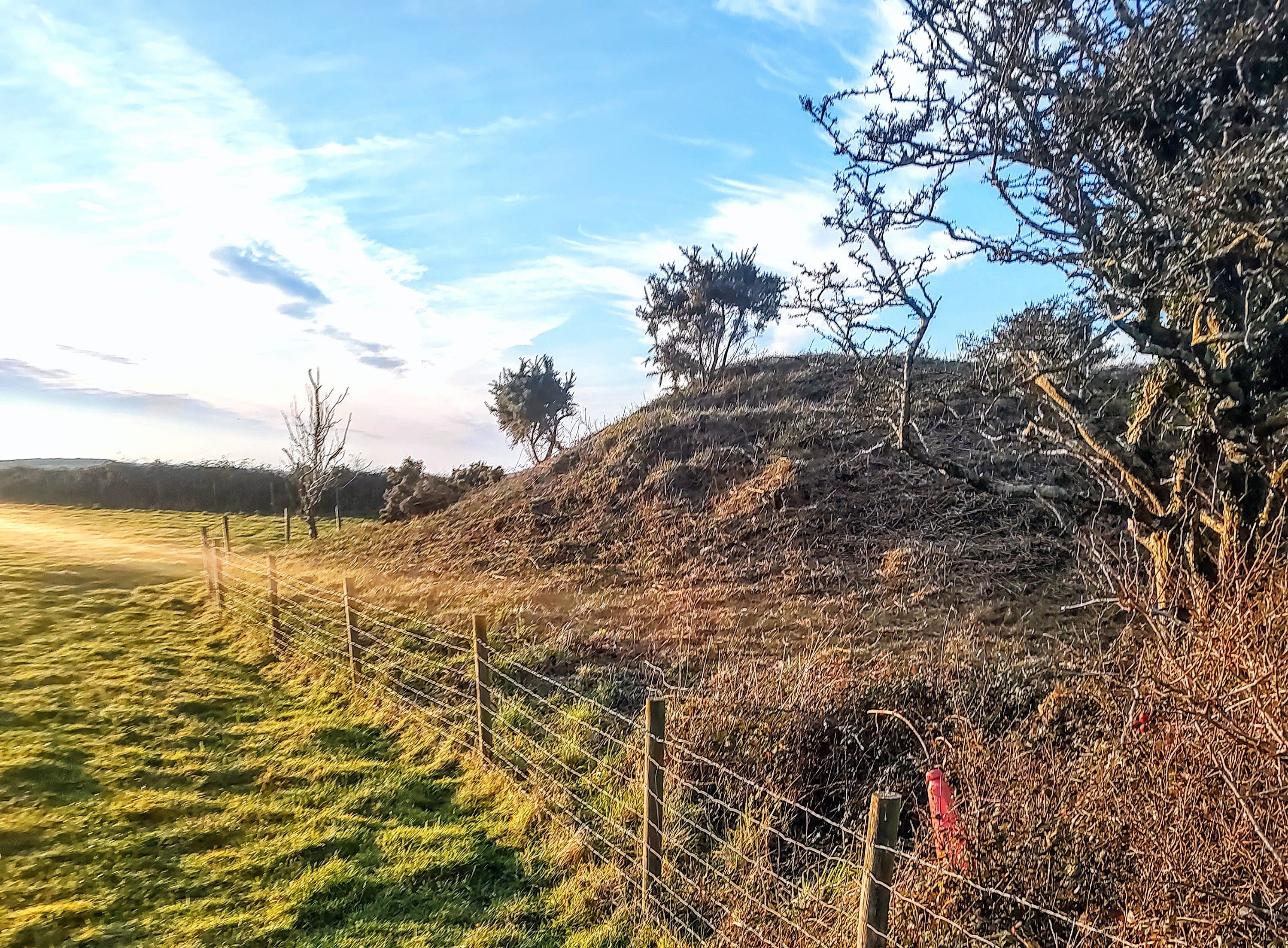
High upon the central spine of Cornwall near Truro, sit four Bronze Age barrows. Straddling the carriageway of what was a stretch of the A30 road between Chiverton and Chybucca, four imposing earth mounds, burial monuments thousands of years old are what remains of a Bronze Age cemetery. They occupy the highest point in the landscape, commanding an extraordinary view across central Cornwall.

When I visited the site near sunset, even through the milky autumn light, I could see the north coast and out to sea; from St. Agnes Beacon, up to Perranporth and as far as Newquay. To the east the highest hills of Bodmin Moor were visible, as well as Carmenellis and Carn Brea to the west. For thousands of years the prominent burial mounds would have stood vigil over the route of a prehistoric trackway that crossed Cornwall and is now closely shadowed by the A30 road. Bowl barrows of this style were built from the late Neolithic period through to the late Bronze Age when they fell out of fashion with their prehistoric builders. Making the dating for Four Burrows barrows anywhere between 2,500 BCE and 1,200 BCE.
One mound sits north of the almost abandoned highway and three to the south, all visible from the road. Ranging in height from 2.5metres to 3.9 metres high, these well-preserved examples of bowl barrows vary between 16 and 24 metres in diameter. A possible 5th and 6th barrows were discovered by the Cornwall Mapping Project south of the remaining monuments but have now been ploughed out. It’s probable these four barrows were part of a much larger cemetery complex between what is today Two Burrows and Carland Cross.
Today two of the barrows have been left to grow wild with gorse and brambles, whilst the larger two are kept neatly, allowing their size and shape to be clearly admired.

The northern most barrow is the largest, and probably the oldest of the set and has been subject to antiquarian investigation with the tell-tale depression in the top of the mound. The scheduled monument was first recorded by Hals in 1740 who writes of an excavation of one of the barrows, named ‘Burrow Belles’ which unearthed a large megalithic structure, a burial cist with three upright stones and roofed two capstones, containing the remains of a cremation within an urn. Unfortunately, it is unknown which barrow. My guess is it is the northern barrow as this style of burial is more typical of the early Bronze age/late neolithic burials.

It is possible that the four barrows at Four Burrows were built generations or even a millennium apart. The most common prehistoric monument in the U.K. the earth mounds take on various shapes and sizes, although sadly many have been damaged by farmers, looters and antiquarians. Often found on high ground, cliff-tops and ridges, many are found in groups, like Four Burrows. Early examples of barrows were erected over burials, and then in the Bronze Age built over cremated remains placed in urns, and sometimes with other goods, in pits or stone cists.
The Four Burrows are bowl barrows, shaped like an upturned bowl and ringed with a ditch, the most found style of barrow in Cornwall. Examination of some barrows in Cornwall revealed they were capped with bright clay, or quartz stones making them distinctive features in the landscape. Four Burrows certainly commands attention and may have been seen, glittering in the sun, from the north coast standing proud against the horizon.

Barrows were often used for secondary burials or even the partial remains of several people. Some barrows excavated have contained no remains indicating they had purposes other than as funerary monuments. It’s possible that barrows were initially built for ritual practice rather than individual burials; possibly for ancestor worship or representing communities rather than individuals. Maybe they were guiding beacons in the landscape for navigation, or for marking territories.
No doubt over the millennia, from the late Neolithic up until the end of the megalithic period, these monuments found many purposes and had various meanings to changing populations. Maybe burial was their secondary purpose, with the monuments already regarded as special for their original use and therefore considered a significant place for burials.

Palden Jenkins on his website Ancient Penwith considers the theory that many barrows were built over intersections of underground streams; perhaps suggesting the barrow mounds are built to cap or contain earth energies. Jenkins explores the theory that some barrows were built in a similar fashion to Wilhelm Reich’s orgone accumulators – which alternate layers of organic matter, stones and sand to accumulate subtle energy. Interestingly, Four Burrows barrows sit near several river tributaries, so it is possible underground water veins run below the site.

Cornwall Archaeological Unit investigated the area between Chiverton and Carland Cross in which Four Burrows barrows sit prior to a road upgrade in 2020. Within this area they found evidence of 10,000 years of human activity, from the Mesolithic (middle-Stone Age period,) and up to the present day. Evidence of flint tool making from 10,000 to 6000 BCE, a prehistoric trackway traversing Cornwall, and bronze age barrows lining the route were found. Today the area is part of a main transport artery across the peninsula of Cornwall well known to locals and visitors travelling to the west of Cornwall. As some of the best examples of prehistoric barrows in Cornwall, the Four Burrows barrows are well worth the visit.