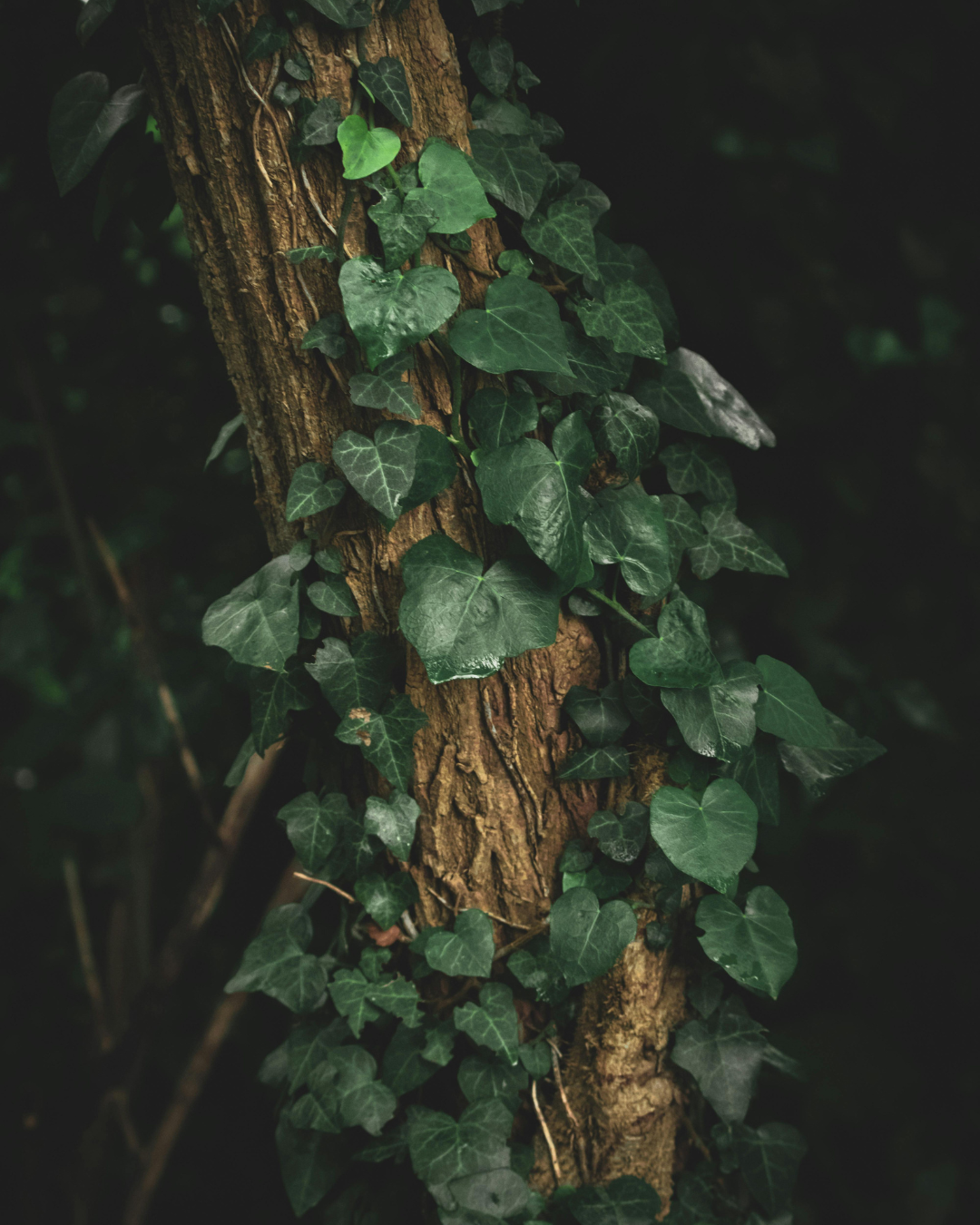
In traditional Cornish folklore ivy was a plant used for divination rituals, using the leaves to tell the future. Young couples would cast a leaf into the fire and the number of cracks it made as it burnt would tell how many years would pass before the couple would marry. Two ivy leaves would be buried in the hot ashes of the fire and the subsequent cracks they made would tell how many children the couple would have.
It was Cornwall’s elders that were most pressed to use the divinatory qualities of the ivy leaf to foretell who was destined to live or die. An ivy leaf, representing each person, would be drawn through a gold ring and then thrown into a vessel of spring water to be left on the hearth overnight. The next morning the leaves would be checked to ascertain their fate. Leaves that had turned black showed who was to die within the year, and any specked with blood red spots foretold a violent death.
A different superstition, also recorded in the 1800’s told, “anyone who wished to dream of the devil should pin four ivy leaves to the corner of their pillow.” (Courtney, 1890) Although why anyone would wish to dream of the Devil I can’t imagine!
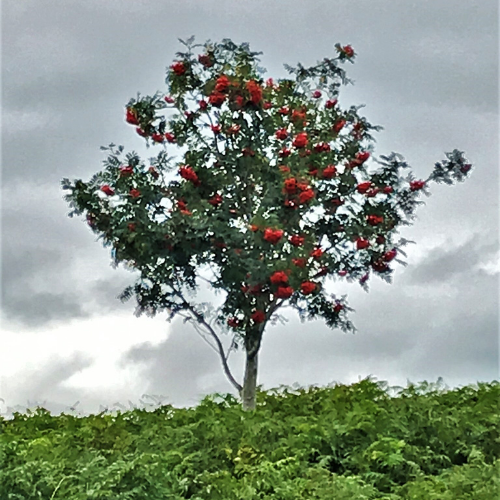
Come autumn the rowan’s berries are at their finest, their hanging bunches putting on a vibrant display of vivid reds and oranges. The rowan tree, also known as Mountain Ash, is not well known for its medicinal benefits but has a long tradition as a ward against evil and the supernatural. Traditionally known as ‘care’, or ‘care-tree’ in Cornwall, (the name probably comes from the Cornish ‘Kerdyn,’) it was revered as a magical tree in Celtic cultures as well as other parts of Northern Europe.
The wood has been known to be used for magical staffs, wands, wards and charms against supernatural ills such as curses. In Cornish folklore it was thought to repel witches by rendering their spells impotent. In Boscastle, the Museum of Witchcraft and Magic displays a collection of wands, one of which is a small pocket-sized wand made of Rowan and bound with colourful threads, known as a ‘keppen’ in Cornish.
Writing in 1884 the Rev. Hilderic Friend, in his book Flowers and Flower Lore, speaks of the rowan tree as a ‘preservative against magic’ in Cornwall, Yorkshire and Scotland.
“In England, Germany and Sweden, its leaves are the most potent instrument against darker powers … Cornish Peasants still carry some (wood) in their pocket to ward off the evil eye.”
Willaim Paynter, the Cornish antiquarian and folklorist wrote that the rowan was the tree most feared by witches and therefore was the greatest protection against them (Cornish Times, 1924.) He spoke of how people Cornish people would fix a piece of rowan wood above their doors to prevent any witch or evil spirit from crossing the threshold. A small piece of rowan, “carried in the pocket will prevent him coming to grief, however drunk he may be,” (Cornish Witchcraft, 1940.)
A small piece of rowan, “carried in the pocket will prevent him coming to grief, however drunk he may be,”
The vibrant berries have been used in spells within Cornwall’s witchcraft traditions, with rowan wands being traditionally used in Candlemas rites (celebrating the end of winter.) In Traditional Witchcraft, a Cornish Book of Ways (2011) The Penwith witch Gemma Gary describes rowan as a wood associated with the fire elements, used for conjuring visions, lifting curses and ill-wishes. She writes, “A walking staff of rowan provides protection from evil when journeying.” She tells us how to make a protective rowan charm.
String 45 dried rowan berries on red thread, with a knot between each berry whilst muttering “rowan berries and red thread; put all evil to its speed.” Pass the charm thrice through smoke then hang over a window or doorway.
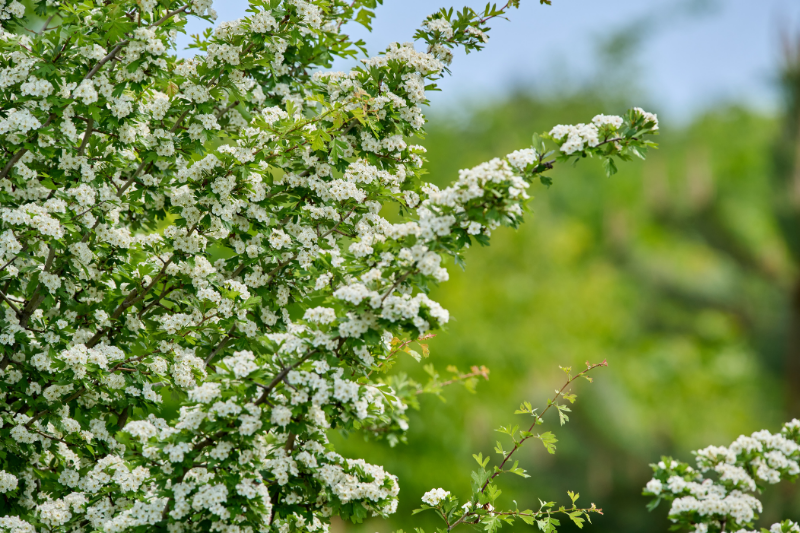
The May-Thorn blossom blooms heralding the changing of the seasons with it’s snowy clouds of petals. The unmistakable perfume of the hawthorn’s delicate white flowers brings the promise of summer on the fresh spring breeze.
This thorny shrub is often found in hedgerows or as small trees standing as lone sentinels in fields and rugged heathland where only the hardiest of flora survive. In Cornwall the impish hawthorn tree is often seen gnarled and twisted, perpetually wind-blown in the fierce Atlantic gales. Looming over the rural lanes from atop the Cornish hedgerows, or stood fast against the elements amongst gorse and heather.
As a seasonal signpost, the hawthorn announces spring with its blossom and greets autumn with its rusty red haws. Blossoming around May Day as the land quickens with life, the Hawthorn is celebrated in the folk customs of the British Isles for marking the birth of summer and the death of winter. For modern pagans the blooming of the hawthorn marks the arrival of Beltane, the Gaelic May Day festival.
May Day Celebrations in Cornwall Today
May-Day is still celebrated today in Cornwall. Obby oss in Padstow, Bolster in St. Agnes, Flora day in Helston, and in Penzance the revived custom of May-Horns. In the past the May-Day was a popular Cornish feast day, or ‘furry day’. Hawthorn blossom was a part of many May-Day folk customs, using the flowers as decoration.
Hawthorn has many names; May Tree, May Blossom, Quick Thorn and Whitethorn. In his book Fern Seed & Fairy Rings, Rupert White tells us how in Cornwall the hawthorn was often called May, Fryth or Aglet Tree. With the young edible shoots often called ‘bread and cheese.’
A tree traditionally sacred in the British Isles, the hawthorn is entrenched in folklore and rich with magical associations. In Celtic mythology the tree is associated with faeries, known to some as faerie-thorn, it marks a liminal space, a gateway to other worlds. It is also known to mark boundaries of sacred lands.
The hawthorn also has dark connotations. Often found standing alone, farmers avoided cutting them down for fear of angering the faeries. Throughout the British Isles it was also considered a dreadful omen of misfortune to bring any cuttings inside the house.
Rupert White tells us, in Cornish folklore it was said that to sit under a hawthorn in May is dangerous, in case you give the faeries power over you. There was also a superstition that young children sitting under the tree may be taken away by the fae.
Hawthorn has medicinal value and is renowned for improving heart health. The leaves, flowers and red berries (or haws), lower blood pressure and are high in vitamin C.