Tag: Cornwall

  • Exploring the Nine Maidens Stone Circle, Wendron

    Exploring the Nine Maidens Stone Circle, Wendron

    2–3 minutes

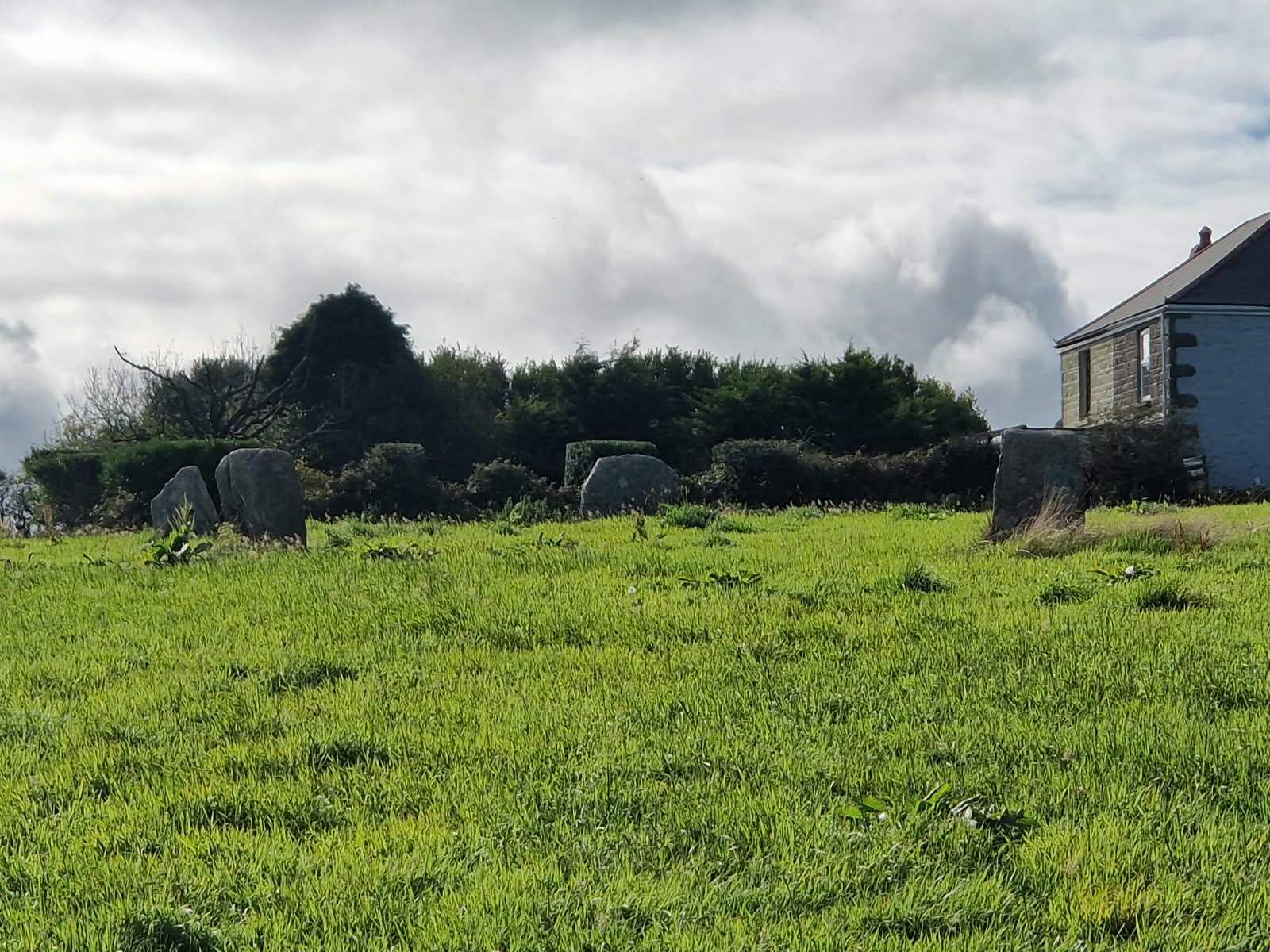
    Near Four Lanes stands what remains of two stone circles. Next to the B3280 the six remaining menhirs survive. Four still standing in situ and two others that have been built into the adjacent stone hedge.

    Thought to be early bronze age the two circles once stood 18 metres apart with now only the south-east circle partially remaining. It originally contained 14 or 15 stones and was 16 meters across. The north-west circle has two stones remaining, but they too have been built into the hedge. The stones themselves are small in comparison to some circles in Cornwall, standing between just 0.8 and 1.2 metres tall.

    One of the menhirs that have been built into the stone hedgerow

    The original Cornish name is Nine Sisters or Naw Whor. Rober Hunt (1865) suggests the monument was named in memory of nine sisters or nuns. A departure from the usual story attributed to British megaliths of maidens turned to stone for disrespecting the Sabbath – as the circle’s English name suggests.

    Sited near the crest of a hill with views of Carnmenellis, and Nine Maidens downs to Crowan Beacon half a mile to the west, north to Carn Brea and even across to the coast at Poldhu on a clear day. The stone circle has a prominent place in a landscape of prehistoric significance. Half a mile west sits Hangman’s Barrow a bronze age cairn, as well as a large standing stone and Burras Menhir roughly two miles to the south. Calvadnack settlement is a quarter a mile to the south, with the remains of round houses hidden in the heather and bracken. The site is thought to be iron age, although there have been bronze age finds close by.

    The view west toward Carnmenellis hill

    Bronze age barrows and cairns are found across this landscape, including the barrow found next to the circle and the cairns on Carnmenellis. Does this suggest a link between the stone circles and the places of the dead. Or where the circles meeting places for neighbouring tribes, bringing people together from the north and south of the area, linking coastal people with the inland tribes.   

    Double, and even triple stone circles are found in Penwith and Bodmin Moor. In 2008 West Cornwall Dowsers believe they found a third site, a possible third circle or an alternative site for the now absent second circle. This circle has a possible alignment to a cairn on the summit of Carnmenellis hill at the equinox sunrise, and possibly Crowan Beacon at midwinter sunset.

    The Merry Maidens in Penwith used to be a double stone circle

    We’ll probably never know the true meaning of the stone circles but it is clear they are sites significant to prehistoric peoples across thousands of years.  

    Map Reference SW681365
  • Celebrating May Day: Hawthorn and Its Traditions

    Celebrating May Day: Hawthorn and Its Traditions

    2–3 minutes

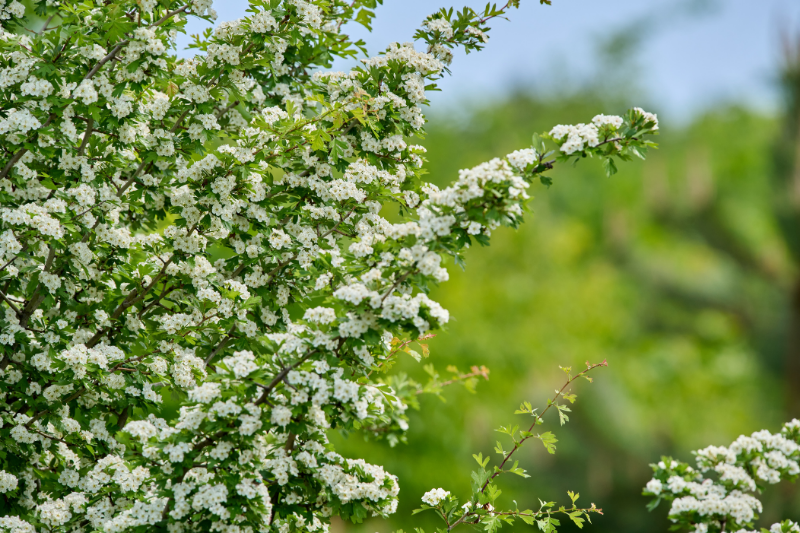
    The May-Thorn blossom blooms heralding the changing of the seasons with it’s snowy clouds of petals. The unmistakable perfume of the hawthorn’s delicate white flowers brings the promise of summer on the fresh spring breeze.

    This thorny shrub is often found in hedgerows or as small trees standing as lone sentinels in fields and rugged heathland where only the hardiest of flora survive. In Cornwall the impish hawthorn tree is often seen gnarled and twisted, perpetually wind-blown in the fierce Atlantic gales. Looming over the rural lanes from atop the Cornish hedgerows, or stood fast against the elements amongst gorse and heather.

    As a seasonal signpost, the hawthorn announces spring with its blossom and greets autumn with its rusty red haws. Blossoming around May Day as the land quickens with life, the Hawthorn is celebrated in the folk customs of the British Isles for marking the birth of summer and the death of winter. For modern pagans the blooming of the hawthorn marks the arrival of Beltane, the Gaelic May Day festival.

    May Day Celebrations in Cornwall Today

    May-Day is still celebrated today in Cornwall. Obby oss in Padstow, Bolster in St. Agnes, Flora day in Helston, and in Penzance the revived custom of May-Horns. In the past the May-Day was a popular Cornish feast day, or ‘furry day’. Hawthorn blossom was a part of many May-Day folk customs, using the flowers as decoration.

    Hawthorn has many names; May Tree, May Blossom, Quick Thorn and Whitethorn. In his book Fern Seed & Fairy Rings, Rupert White tells us how in Cornwall the hawthorn was often called May, Fryth or Aglet Tree. With the young edible shoots often called ‘bread and cheese.’

    A tree traditionally sacred in the British Isles, the hawthorn is entrenched in folklore and rich with magical associations. In Celtic mythology the tree is associated with faeries, known to some as faerie-thorn, it marks a liminal space, a gateway to other worlds. It is also known to mark boundaries of sacred lands.

    The hawthorn also has dark connotations. Often found standing alone, farmers avoided cutting them down for fear of angering the faeries. Throughout the British Isles it was also considered a dreadful omen of misfortune to bring any cuttings inside the house.

    Rupert White tells us, in Cornish folklore it was said that to sit under a hawthorn in May is dangerous, in case you give the faeries power over you. There was also a superstition that young children sitting under the tree may be taken away by the fae.  

    Hawthorn has medicinal value and is renowned for improving heart health. The leaves, flowers and red berries (or haws), lower blood pressure and are high in vitamin C.  

  • Pawton Quoit: A Stone Age Enigma in Cornwall

    Pawton Quoit: A Stone Age Enigma in Cornwall

    Pawton Quoit is a magnificent portal dolmen built by Cornwall’s stone age inhabitants. The imposing megalith sits, mostly intact, atop a ridge overlooking a steep valley.

    Also known as Giant’s Quoit, the monument is found along the back lanes of Wadebridge, up a private farm track. The enormous capstone, which juts out incongruously against the landscape, must weigh at least 15 tonne, and perches on just three points of the supporting upright stones. Part of it has sheared off, and sits where it fell in front of the quoit’s façade. The dolmen sits on a raised earthen mound, perhaps the vestiges of a cairn that covered some or all of the monument.

    In Cornwall we call dolmen quoits. A reference to the folk belief that Cornwall’s many megaliths were created by giants throwing stones at each other – quoit being a reference to the dolmen capstones resembling the discs thrown in a traditional game of quoits.

    Cornwall’s quoits are thought to have been built in the early to mid-neolithic period. We can only wonder at the engineering skill, and size of the labour force required, to accomplish such a feat in the stone age. The society that built the quoit would have been organised, and have enough abundance to spare those workers from the business of farming food. Moving the huge capstone up the hill, and placing it on top of the uprights, would have been an extraordinary feat. The enormous size of it would have been impractical, and much larger than required to cap the chamber – it’s a statement.

    The accomplishment of an immense engineering project like Pawton Quoit must have inferred status upon the community responsible. Portal dolmens would have been visually impressive, dominant markers in the landscape, looking over neolithic settlements and fields. Cornwall would have been mostly covered in dense temperate rain forest, except for small areas cleared for farming and settlement. Hilltops, like this one, would have been beacons rising out of the humid, wild tangle of forest, serving as places of safety and gathering.

    Part of the capstone has sheared off and sits in front of the dolmen’s facade

    In Cornwall quoits are often found overlooking valleys with a water source, or in places where neolithic settlements and fields have been found. These first farmers transformed the landscape for agriculture and permanent settlements. They were also the first megalithic builders, modifying their environment with monuments like Pawton.

    The day of my visit the weather is wild, we are lashed by a squall of wind and rain blowing in off the North coast. In the early Neolithic period, the climate would have been warmer and drier than it is today. The hilltops, ridges and tor summits would have been more hospitable to settlement before the climate changed in the early bronze-age.

    The original purpose of portal dolmen is unknown. It’s possible they were territorial, or used for burial and funerary rites. Although little human remains have been found, suggesting their primary purpose was something else. Given how architecturally impressive quoits like Pawton are, it seems they were meant to be seen. Were these marvels of prehistoric engineering built to meet the needs of the living, rather than those of the dead.

    They could be cathedrals of spiritual significance, marking places considered sacred. Possibly for capturing earth energies, or marking the seasons through solar and astral alignments. Maybe the quoits were built to bring people together in ways we can’t imagine in our modern world that’s so disconnected from nature. Maybe these monuments were built for worshipping gods that have long been forgotten.

    Or maybe, just maybe, the Cornish giants were real.

    From Popular Romances of the West of England . Robert Hunt, 1865
  • Exploring the Mystery of the Nine Maidens Stone Row

    Exploring the Mystery of the Nine Maidens Stone Row

    2–4 minutes

    The Nine Maidens stone row stands in a field immediately south of the A39.  The early bronze-age monument sits in a field on Breock Downs between St Columb Major and Wadebridge. Nine irregular arrow shaped menhirs stand in a row running SW to NE, parallel to a small stream whose banks are littered with what appear to be large field clearance stones.

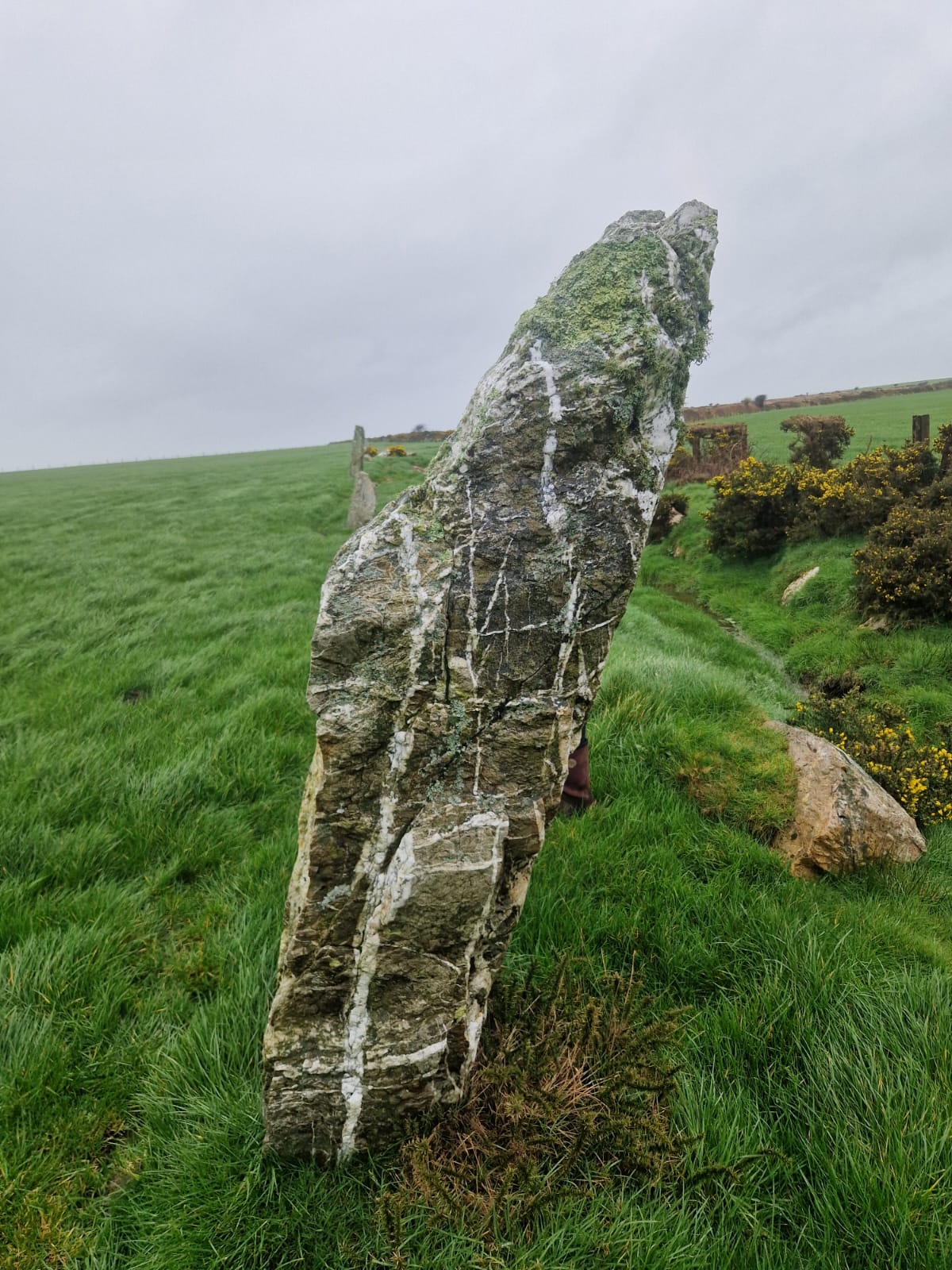
    Standing from 0.8 metres to 1.9 metres tall, with one recumbent stone 3 metres in length, the menhirs are local grey slate rich with thick quartz veins weaving elaborate paths across them. They are living breathing stones hosting their own eco system of mosses and rare lichens.

    To access the stone row, you pass a sleeping hawthorn tree looming over a pool of water. The lone hawthorn is known in Celtic mythology as a fairy tree, a gateway between worlds, a marker of ancient boundaries and sacred ground. It would seem to those early bronze-age people that this ground was indeed sacred. To the North-East of the row there is a solitary menhir, now fallen and broken up, known as The Fiddler, or Magi Stone, which stood on the same alignment as the maidens. The monolith and the stone row are possible ceremonial parts of a bronze-age complex of sites, leading to the burial barrows on the highest point of the ridge.

    Views from the barrows on the hilltop north of the Nine Maidens

    Standing on top of the largest barrow, to the south I can see the iron-age hill-castles of Castle an Dinas and Demelza Castle, to the east the highest points on Bodmin Moor, Rough Tor and Bronn Wennili (Brown Willy) are visible. Looking to the north I can see Padstow Bay, and north-west along the coast to Trevose Head, the site of an iron-age cliff-castle and a headland that has given up numerous bronze-age finds. Territorially this hillside would have been an important location.

    The fields and hedgerows surrounding the monument are littered with large stones, similar to those used in the stone row. Most of these are a result of field clearances, but some look suspiciously similar in shape and size to the stone row menhirs, with thick quartz veins. I can’t help but wonder if there were more stones to this row, or if it’s possible there were other stone monuments in the complex.

    Richard Carew in his Survey of Cornwall (1602), names the site The Sisters, and John Norden, in 1728, mentioned another adjoining site he called the Nine Sisters, which may have been a double stone row or circle. In 1995 a team of dowsers believe they found 4 more stones to the row and a second stone row 25ft to the west of it. (Cheryl Straffon, 2004.)

    Breock Downs itself is home to other significant prehistoric monuments, including the neolithic dolmen Pawton Quoit, and Men Gurta the largest monolith in Cornwall. It seems reasonable to assume that this was a culturally significant area of ancient Cornwall, a landscape rich with meaning. Were the Nine Maidens a processional monument leading to the peak of the hill where the prominent burial barrows sit. Was this spot a node in a network of hills, ridges and beacons across the spine of mid-Cornwall.

    The Nine Maidens will no doubt continue to keep their secrets close, and give us only questions, but it’s the mystery of these Cornish megaliths that has captured imaginations for millennia after millennia.

    Map Ref: SW93636754  Latitude: 50.471271N  Longitude: 4.909599W

  • Cornish Holy Wells: The Story of Dolly Dunking

    Cornish Holy Wells: The Story of Dolly Dunking

    2–3 minutes

    A peculiar custom, once forgotten, Dolly dunking is a Cornish tradition where young girls would take their dolls to blessed in holy wells on Good Friday. A custom which has documented since the 1800’s.

    In Cornish Feasts and Folklore (1890) M.A. Courtney recorded, “On the afternoons of Good Friday, little girls of Carharrack, in the parish of Gwennap, take their dolls to a stream at the foot of Carn Marth and christen them.” However, local anecdotes say this took place at Figgy Dowdy’s Well, also known as Margery Daw’s Well, located near the top of Carn Marth hill.

    The same custom was observed at Fenton Bebibell sacred spring in west Penwith. (Cornish Homes and Customs, 1934) Named fenten byghan bobel in Cornish, which translates as “Well of the Little People,” this is a possible reference to the small people of Cornish folklore.

    Cornish holy wells, and sacred springs, are thought to be places where spirits dwell, to whom offerings would be made for healing, blessings or foretelling. The custom of ‘dolly dunking’ could hark back to folk memories of ancestral spirits who dwelt in, or nearby, springs and the offerings people made to them.

    Alternatively, the ‘little people’ could be a reference to the blessing and naming of babies, a practice that may have once taken place at holy wells. It’s possible these traditional rituals were being remembered and acted out by young girls with their dolls.

    Good Friday doll blessing is a tradition that has been revived by CASPN at Fenton Bebibell in Morvah, which sits near the Men an Tol monument. The Cornish Ancient Sites Protection Network resurrected the custom 18 years ago and now do an annual ‘dolly dunk’ on Good Friday. The well was lost to the bracken and gorse of the heathland for decades until it was accidentally rediscovered in the 2000’s.

    Is it possible that the tradition of dolly dunking, whatever its origins, was once widespread across Cornwall’s holy wells and springs. Taking place in isolated, insular communites, that weren’t in the habit of writing things down, the local customs were lost to time. Leaving us with only scant records of this peculiar Cornish tradition.

    We can thank CASPN for keeping this part of old Cornwall alive for future generations.

    Figgy Dowdy’s Well Map Ref: SW7146740637  Latitude: 50.221485N  Longitude: 5.205112W Fenton Bebibell Map Ref: SW429352 Latitude: 50.160957N  Longitude: 5.601117W

  • Discover the Traditions of Imbolc and the Cornish Furry Nights

    Discover the Traditions of Imbolc and the Cornish Furry Nights

    2–3 minutes

    What is Imbolc?

    Otherwise known as Candlemas, Brigid’s or St. Brigit’s day, Imbolc is an ancient Celtic fire festival celebrating the first whispers of Spring as winter comes to a close. Usually celebrated on February the 1st or 2nd, Imbolc marks the mid-point between Winter Solstice and the Spring equinox, when the first hardy shoots of life emerge from the soil. Imbolc means ‘in the belly’ – a probable reference to the time of year when pregnant ewes start to lactate, marking the beginning of the agricultural year.

    As far as we know celebration of Imbolc stems from an iron-age Celtic practice, associated with the Gaelic goddess Brigid and the Brythonic Goddess Brigantia. Both goddesses of fire and fertility are connected with the coming of spring and this fire festival, which is one of the cross-quarter days that make up the Celtic wheel of the year.

    Throughout the British Isles there are neolithic (late stone-age) monuments that align with the rising of the sun at Imbolc – the mid-point between the winter solstice and spring equinox. This suggests that this time of year has been marked as significant since long before the Celtic people arrived on these isles.

    Furry Nights

    In Cornwall the Celtic quarter nights are known as the Furry Nights, or Troyl Nights , meaning feast or celebration. Imbolc, or Candlemas as it is known in Cornwall, is also known as the ‘feast of lights’. Not strictly guided by the calendar, in Cornwall the feast of lights would be guided by nature and those first signs of life, like the arrival of snowdrops. A traditional Cornish drink of ewe’s milk, honey, cider and mashed apples would have been drunk to mark the start of the farming season.

    Cornish Cunning-Folk

    Cornish cunning-folk would ritually mark the end of winter and the return of the sunlight as the days noticeably lengthen. Traditionally fires and candles would be lit to awaken the earth’s life force from its winter slumber. A witch’s powers would be renewed with the coming spring, a time to re-empower charms and such like. A traditional rite would involve a night time procession by candlelight to a holy well, where offerings would be made, small fires would be lit, and the life-force encouraged from the portal of the water.

    Cornwall’s Megaliths

    The neolithic people of the Cornish peninsula may have also marked this time of year through various megalithic monuments. Boscawen-Un stone-circle appears to have an Imbolc solar alignment, with the sun setting between the centre and quartz stones (if you stand on the opposite side of the circle.) on February 1st.

    There is another possible solar alignment with the Imbolc sun setting over the now disappeared Boleigh circle, when watched from it’s twin circle the Merry Maidens. Given how many megalithic monuments are now lost or partially destroyed, I would imagine it is likely there were other alignments with Imbolc and other significant dates in the solar and farming calendars.

    How do you mark this time of year? Here in Cornwall I like to sow my first hardy seeds undercover when I see the first snowdrops, and the bluebell shoots poking through the soil. What are your signs that spring is on its way?

    Follow me on BlueSky

  • Exploring the Mystical History of Merry Maidens

    Exploring the Mystical History of Merry Maidens

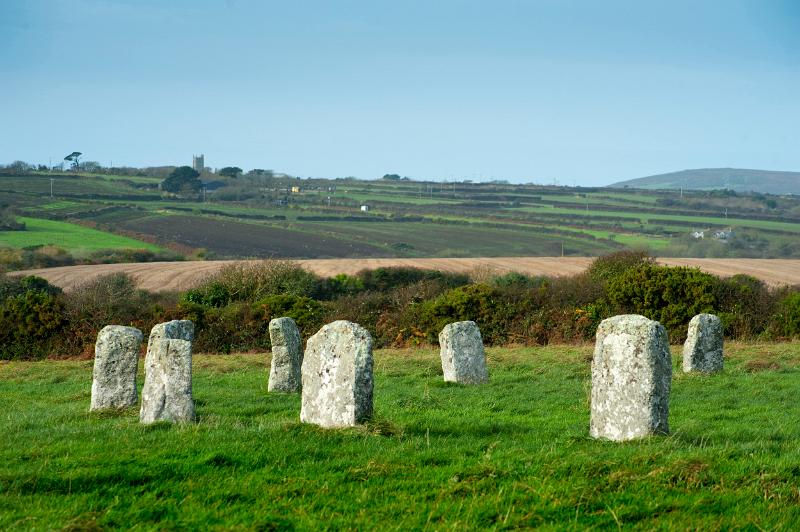
    Cover Image: Merry maidens, Penwith. From photoeverywhere.co.uk

    The Merry Maidens, one of Penwith’s four remaining stone circles, are a fine example of a Cornish megalithic monument. A perfect seventy-eight-foot circle, consisting of nineteen granite stones of around four foot in height.

    Once named ‘Dans Maen’ – ‘Dance of Stones’ in Cornish, this is a probable reference to the monument’s adulterated Christian origin myth – maidens turned to stone for dancing on the Sabbath.  

    Often coined as ‘The Cathedrals of the Prehistoric,’ I find stone-circles the most atmospheric and magical of all megalithic sites. The most accepted dating for these monuments is from the early bronze age – 2500 – 1600 BC, although due to a lack of archaeological evidence they remain an enigma of prehistoric society.

    Could they be calendars of stone, wheels of time marking nature’s cycles, following celestial movements, harmonising with earth and cosmos. Or spaces for gatherings, festivals and rites of passage.

    There are thought to have been around ten other stone circles in the Penwith district of Cornwall, most now lost or destroyed.  The Merry Maidens monument itself had a twin circle, a few hundred metres to the east, also sadly destroyed by farmers.

    The high quartz content of these granite menhirs could explain some of the unusual sensations, such as electric shocks reported by visitors to the monument, for quartz is known for its piezo-electric effect.

    Sitting upon the North-facing slope of a hill, above a wooded valley, you can see the notable prehistoric sites of Chapel Carn Brea and Sancreed Beacon from the circle (Carn Galva on the north coast can be seen on a clear day,) suggesting its significance in the landscape.

    This megalith was once part of a greater complex of bronze-age sites.  Within half a mile stand the epic twin menhirs The Pipers, as well as four other bronze-age standing-stones, barrows and even a neolithic cairn. Maybe these sites are key nodes in a network of megalithic monuments which turned the wider landscape into a charged space.

    Some megalith pilgrims have reported peculiar goings on at the Merry Maidens, such anomalous lights and strange disembodied voices.

     Large magnetic variations have been recorded, unusual electromagnetic phenomena that has been known to deflect compass readings. The stones themselves are flattened on the inside and curved on the outside of the circle, which could suggest the possibility that the circle itself acted as some kind of resonator or amplifier.

    These are all curious theories that fire the imagination.

     The neolithic inhabitants of this land were the first to make their mark, the first to adorn and shape the landscape to their liking. Here in the southern half of the Penwith district this process seems to have started with Tregiffian barrow (the chambered cairn that sits just south of the Merry Maidens) and continued through the latter half of the bronze-age, with standing menhirs, holed stones and of course the stone circles.

    In the wooded valley below, in Boleigh, there is evidence of an iron-age settlement and a fine intact example of the uniquely Cornish iron-age fogou.

    Is it possible the Merry Maidens were the crowning glory of a sacred landscape revered over millennia?

    First Published in Ancient Times: Vol. 1

    Share your experiences with the Merry Maidens comment below

    Follow me on BlueSky

  • Welcome to the Uncanny Cornwall Blog!

    Welcome to the Uncanny Cornwall Blog!

    Cornwall, a land rich in myth and legend, with it’s ancient living landscapes and mysterious monuments, it has long been associated with the strange and the unknown.

    As an isolated peninsula, Cornwall has retained its ancient folklore and traditions. The Cornish people have kept strong connections with their Celtic past and the old ways passed down through legend and custom.

    With its many ritual landscapes, and numinous megaliths, thousands of years of Cornish history can be found amongst its wild liminal spaces.

    In Cornwall you’ll find standing stones, holy wells, iron-age fogous, spectacularly sited cliff-castles, bronze-age stone circles, neolithic quoits and tor enclosures.

    Cornish folklore is rich with giants, fairies, little people, mermaids and other otherworldly inhabitants. Whilst Cornish feast days and seasonal customs align with ancient Celtic traditions.