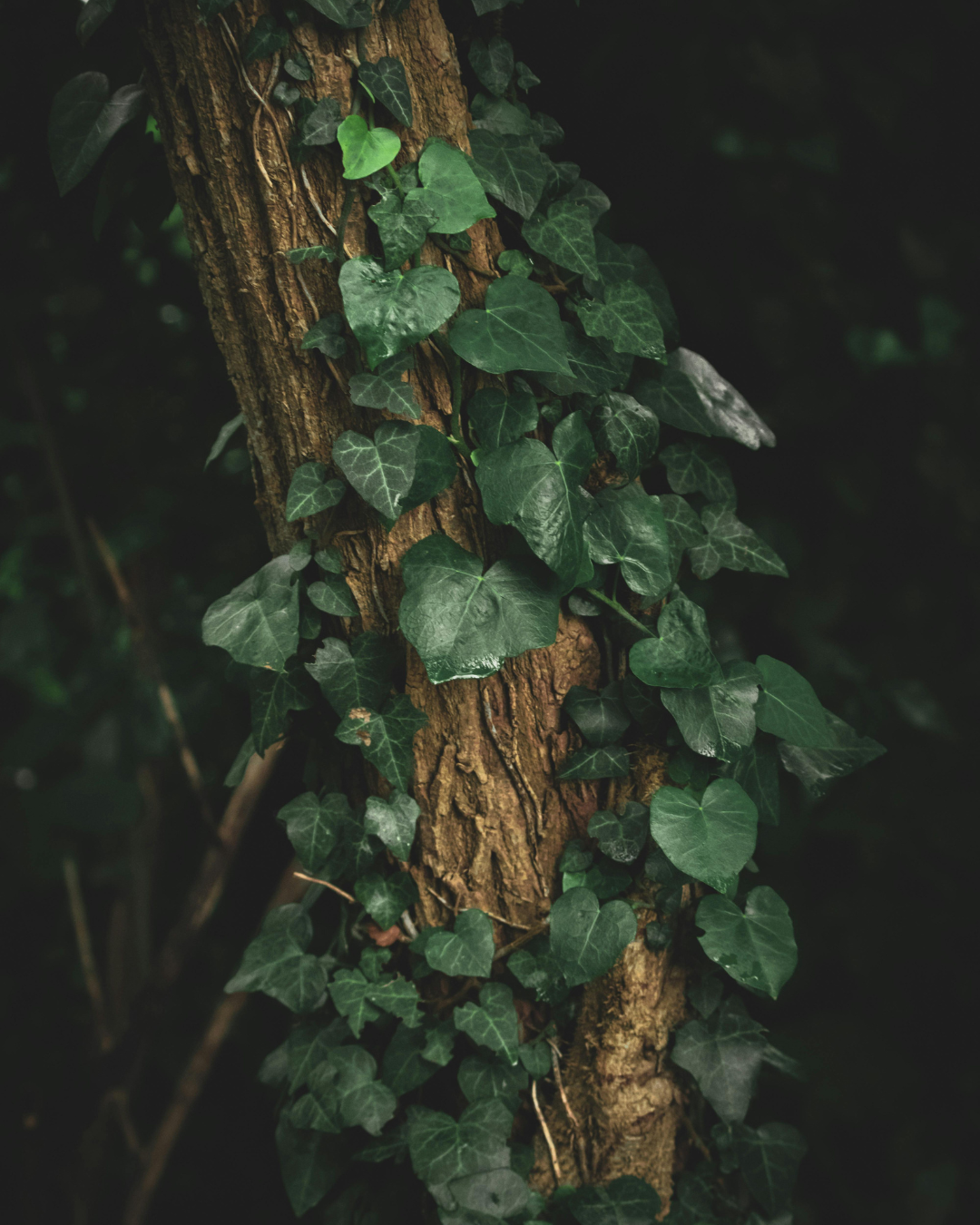
In traditional Cornish folklore ivy was a plant used for divination rituals, using the leaves to tell the future. Young couples would cast a leaf into the fire and the number of cracks it made as it burnt would tell how many years would pass before the couple would marry. Two ivy leaves would be buried in the hot ashes of the fire and the subsequent cracks they made would tell how many children the couple would have.
It was Cornwall’s elders that were most pressed to use the divinatory qualities of the ivy leaf to foretell who was destined to live or die. An ivy leaf, representing each person, would be drawn through a gold ring and then thrown into a vessel of spring water to be left on the hearth overnight. The next morning the leaves would be checked to ascertain their fate. Leaves that had turned black showed who was to die within the year, and any specked with blood red spots foretold a violent death.
A different superstition, also recorded in the 1800’s told, “anyone who wished to dream of the devil should pin four ivy leaves to the corner of their pillow.” (Courtney, 1890) Although why anyone would wish to dream of the Devil I can’t imagine!
Halloween, or Nos Kalan Gwav in Cornish, ‘eve of the first day of winter’ (first day of winter = kalan gwav.) is a traditional feast day, also known as a ‘furry night,’ in Cornwall. Nos Kalan Gwav is a celebration of the changing seasons, marking the start of winter, for giving thanks for the harvest, whilst marking the transition to the darker months of the year when the plants die off and the world slumbers.
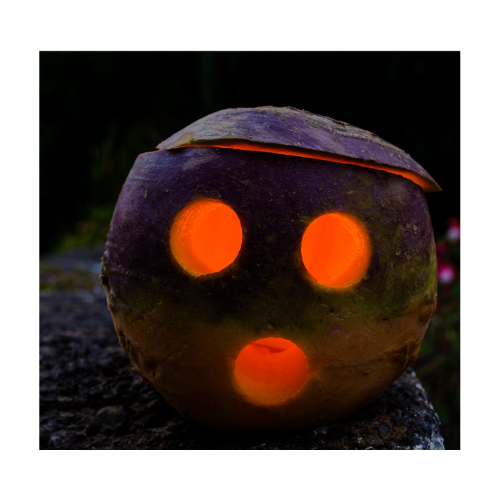
The original Jack O Lanterns were not carved out of pumpkins, but turnips and other root vegetables, in Celtic nations such as Cornwall, Ireland and Scotland. Carved to ward off any unwanted spirits walking the earth whilst the veil between worlds was thinnest, and the supernatural more possible, on All Hallows Eve, which was also known as Allantide in Cornwall. ( Similarly named to the Welsh and Manx celebration of Hollantide, both English names for the Celtic festival.)
This was a time for feasting and forging the social bonds necessary to prepare for the coming of winter.
The gifting of apples was often a feature celebrations, given as gifts for good luck. It was said if a young woman put an apple under her pillow she would dream of her future husband. In the west of Cornwall they were known to nail two pieces of wood into an X and attach candles to each arm with apples hung between them.
Allantide was also a feast day associated with games of divination. There were many charms for young women to discover if they would be married or not, and what kind of person that future husband be. One game involved pouring molten-metal through the handle of a key in a bowl of water to see what shapes the metal would make, to foretell what trade a future husband would have. Or she could write names onto slips of paper, ball them up and put them in a deep basin of water. The first name to unfurl and rise to the top would be the name of the future spouse.
For Cornwall’s pagan communities Nos Kalan Gwav is a time to contemplate death and remember the ancestors. The shifting of the seasons, the gates of winter opening, welcoming us into the dark, creates an opening between the worlds of the living and the dead. October 31st is also a traditional quarter-day in Celtic traditions, being equidistant between the autumn and winter equinoxes.
Practices which hark back to ancient Celtic traditions reveal that today’s Halloween celebrations have their roots in rituals that date far back in time. Feast days were a crucial part of our farming ancestor’s social calendar, marking the changing of the seasons was crucial to their survival. Observing the occasion today, whether you carve pumpkins or turnips, is a thread of connection to a time when we were all more in tune with the natural world.
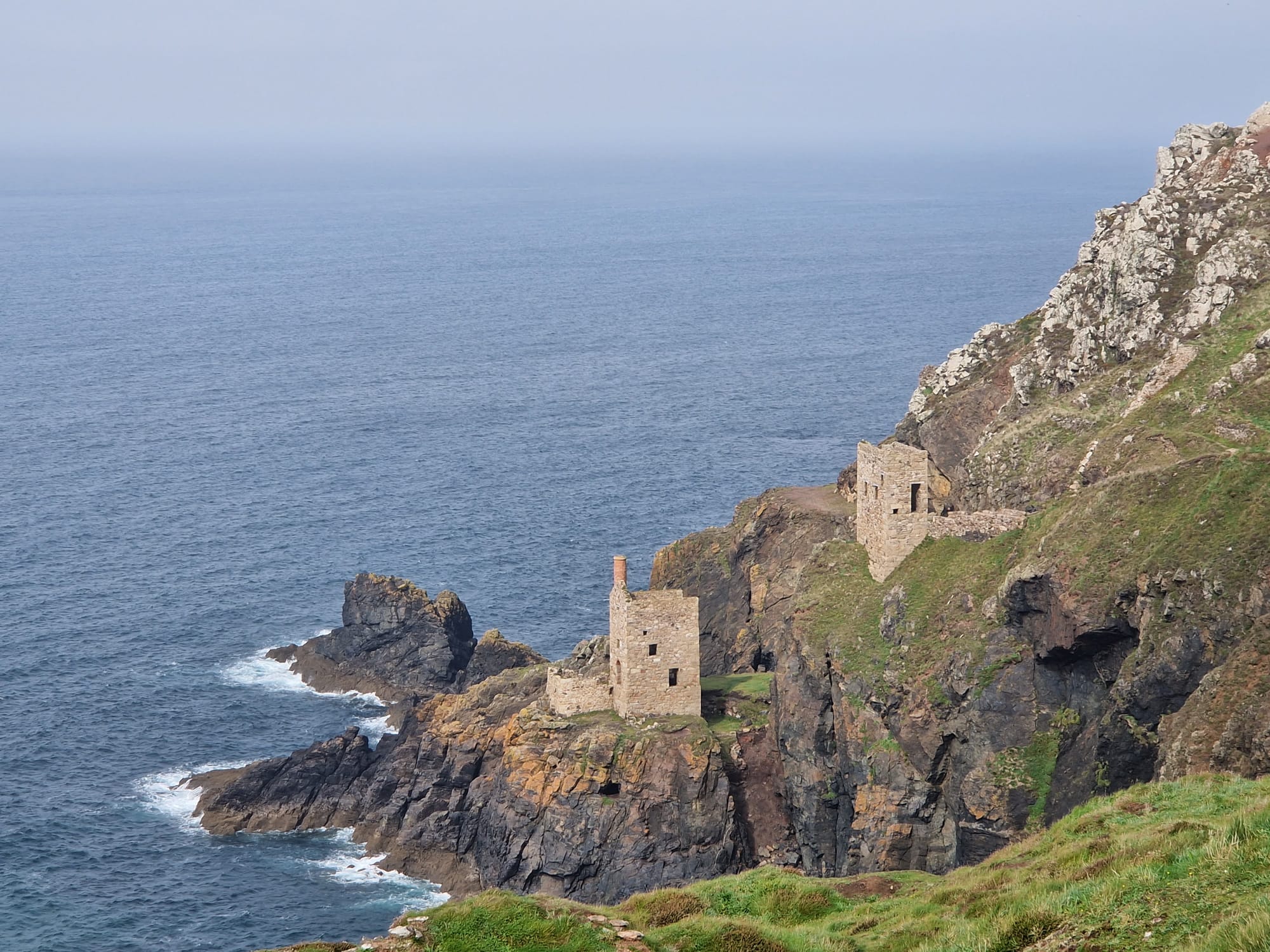
One stormy night, in a tin-stamping mill at Botallack, miners gathered for their regular game of cards. The mill sat above a deep chasm in the cliff, the miners game was scored by the sound of waves booming aginst the cliffs below and the rain furiously lashing at the walls. Yet, huddled around their lamp they were warm and dry for a change, and laughed in good spirits as they played their rounds.
Botallack Mine in the 1800’s
After four hands had been played there was a knock at the door of the mill. They welcomed the stranger in out of the rain and invited him to join their game. The enigmatic stranger spoke with an unusual accent and was not at all damp, despite coming in out of the deluge. But the miners were well on their way to drunk by now, having a few shots of gin each, so they did not question him as they should.
The man had the gift of the gab, and the gift of the cards, for he won every hand whilst regailing the miners with tales of the lands he had visited. They played on, drinking and laughing with the stranger, on the gin the miners became raucous in their revels. The whole night past them unoticed.
The light of dawn eventually lit up the windows with a golden glow illuminating the mysterious stranger in his seat. One by one the miners were struck sober by the sight of the man’s feet. They were the cloven hooves of the devil.
The Jowle – Cornish for Devil
They still call that chasm in the cliff, Stamps an Jowle Zawn – “chasm of the devil’s stamps,” in Cornish. (Craig Weatherhill, Myths and Legends of Cornwall, 1994)
In the far-west of Cornwall, on the coast of Penwith, a tale of lovers takes a dark and ghostly turn. Nancy Trenoweth was a simple uneducated girl whose world consisted of little but Lands-End, who certainly never travelled east of Penzance. She was put into domestic service with the Lenine family of Boscean, where she met the young and handsome Frank Lenine. The two fell in love and soon became devoted to one another.
Besotted, Frank asked his parent’s permission to marry his sweetheart. Unfortunately for the lovers the Lenine’s were shocked, horrified at the thought of their precious son marrying a Trenoweth. For the elder Nancy Trenoweth was known in the area as someone with considerable power in the ways of nature spirits, known for her belief in animism, the belief that every living thing contains a form of spirit. She was not feared so much as respected, but this was not a family Frank’s father would tolerate any association with so he refused his son. Also Nancy’s employer, he sent her away to serve as a maid at another house.
In defiance of his parent’s wishes, Frank and Nancy continued to have midnight trysts and made vows to each other next to Logan Rock. When Nancy’s parents discovered the inevitable had occurred, she was pregnant with Frank’s child, they demanded he marry their daughter. The Lenine’s resolved to never allow this to happen and sent their son away to sea on a ship bound for India. Neither Frank nor Nancy could write, so they had no sight or word of each other for three long years. Nancy’s mother took care of the baby and sent Nancy off into service again at a house in the village of Paul near Mousehole. The Lenine’s demanded the Trenoweth’s give the child over to them to raise, but Nancy’s mother refused.
Three years after Frank’s departure, driven by her desperate desire to see her lover again, Nancy was to make a dreadful mistake. On All Hallow’s Eve she was persuaded by two other maids to cast a spell by ‘sowing hemp-seed’ and chanting an incantation three times,
“Hemp-seed I sow thee, Hemp-seed grow thee; And he who will my true love be, Come after me and shaw thee.”
Looking back over her left shoulder she saw Frank Lenine once again, but to her fright but he was snarling with rage. Frightened, she screamed which broke the spell and he disappeard.
November followed with great storms crashing in off the Atlantic Ocean. One night, a large vessel was lost upon the rocks and smashed to pieces in the pounding waves. The bodies of the sailors washed ashore, and amongst them was the dying Frank Lenine.
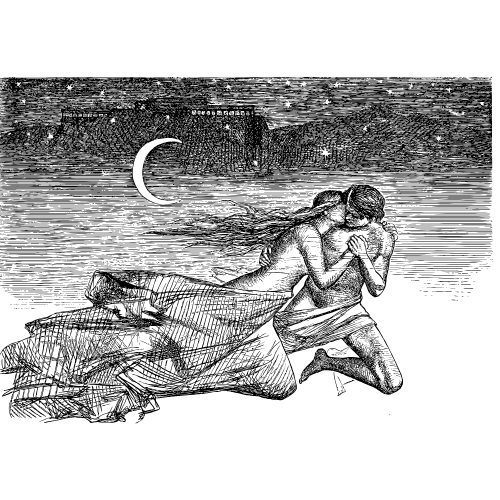
The only words he spoke were spoke to call for Nancy to be sent to him so they could wed before he perished. Nancy was not informed of Frank’s death and burial in Buryan church yard. So when on the night of the funeral, a horsemen rode up to Nancy’s house and hailed her by her name she came willingly. It was the voice of her lover, back home at last, he told how that at the first chance he had he rode to find her to make her his wife as soon as possible. Giddy with the excitement of seeing her lover Nancy took his hand and leapt up onto the horse behind him. As she did so she realised his hand was deathly cold and she soon felt an icy grip creep up her arm. She succumbed to the spell of the pale and sorrowful horseman and seized with fear she found herself speechless with no power to save herself.
The rider took off with Nancy, across the moor drenched in moonlight, they rode furiously. As the rider took them through the river Nancy caught their reflection in the water. This her first proper look of the horseman; with horror she saw the rider was dresssed in grave clothes and wrapped in a burial shroud. As they rode through Buryan Churchtown Nancy regained her voice and cried out for help. The blacksmith sprang from his doorway and seized hold of Nancy and using his hot iron he freed her dress from the spirit’s cold grip. The rider sprang away and disappeared as he reached Frank Lenine’s grave.
The blacksmith rushed the half-dead Nancy back to her parent’s house. Upon her deathbed she instructed her mother to give the child to the Lenine’s, and for herself to be buried on top of her lover.
There were two sailors who also survived the wreck of Frank’s ship and recounted how on All Hallow’s eve he was distressed, eventually collapsing as if dead upon the ships deck and lay unconscious for hours. Upon his waking he recounted how he had been taken to Nancy. Furious he declared that if he ever married the young woman who had cast the spell to summon him, he would make her suffer the longest day she had to live for drawing his soul out of his body.
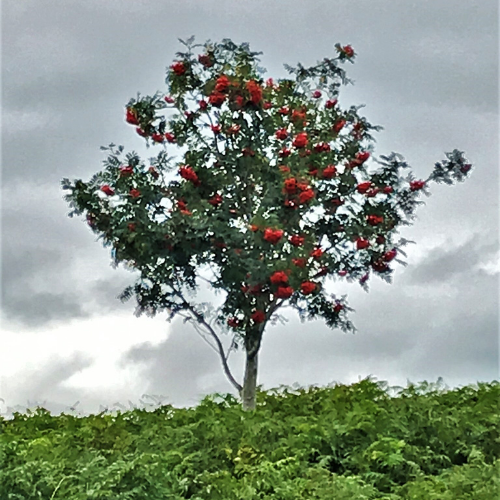
Come autumn the rowan’s berries are at their finest, their hanging bunches putting on a vibrant display of vivid reds and oranges. The rowan tree, also known as Mountain Ash, is not well known for its medicinal benefits but has a long tradition as a ward against evil and the supernatural. Traditionally known as ‘care’, or ‘care-tree’ in Cornwall, (the name probably comes from the Cornish ‘Kerdyn,’) it was revered as a magical tree in Celtic cultures as well as other parts of Northern Europe.
The wood has been known to be used for magical staffs, wands, wards and charms against supernatural ills such as curses. In Cornish folklore it was thought to repel witches by rendering their spells impotent. In Boscastle, the Museum of Witchcraft and Magic displays a collection of wands, one of which is a small pocket-sized wand made of Rowan and bound with colourful threads, known as a ‘keppen’ in Cornish.
Writing in 1884 the Rev. Hilderic Friend, in his book Flowers and Flower Lore, speaks of the rowan tree as a ‘preservative against magic’ in Cornwall, Yorkshire and Scotland.
“In England, Germany and Sweden, its leaves are the most potent instrument against darker powers … Cornish Peasants still carry some (wood) in their pocket to ward off the evil eye.”
Willaim Paynter, the Cornish antiquarian and folklorist wrote that the rowan was the tree most feared by witches and therefore was the greatest protection against them (Cornish Times, 1924.) He spoke of how people Cornish people would fix a piece of rowan wood above their doors to prevent any witch or evil spirit from crossing the threshold. A small piece of rowan, “carried in the pocket will prevent him coming to grief, however drunk he may be,” (Cornish Witchcraft, 1940.)
A small piece of rowan, “carried in the pocket will prevent him coming to grief, however drunk he may be,”
The vibrant berries have been used in spells within Cornwall’s witchcraft traditions, with rowan wands being traditionally used in Candlemas rites (celebrating the end of winter.) In Traditional Witchcraft, a Cornish Book of Ways (2011) The Penwith witch Gemma Gary describes rowan as a wood associated with the fire elements, used for conjuring visions, lifting curses and ill-wishes. She writes, “A walking staff of rowan provides protection from evil when journeying.” She tells us how to make a protective rowan charm.
String 45 dried rowan berries on red thread, with a knot between each berry whilst muttering “rowan berries and red thread; put all evil to its speed.” Pass the charm thrice through smoke then hang over a window or doorway.
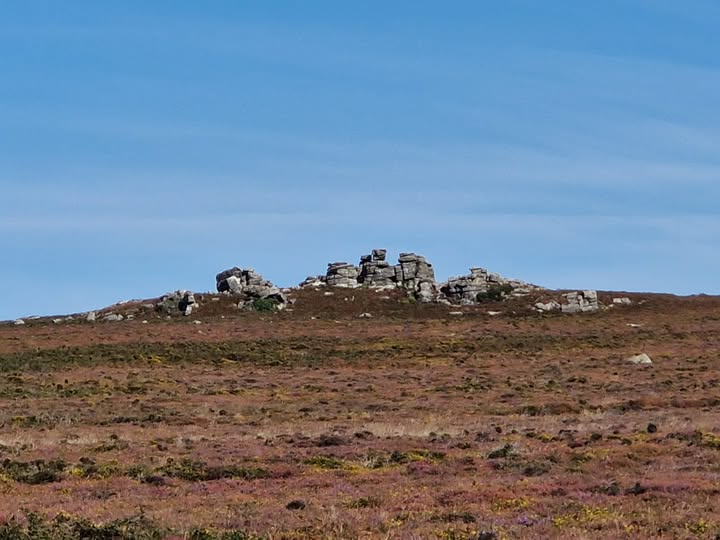
Crowning the Gump upon Penwith Moor sits Carn Kenidjack with its striking stack of granite boulders. The hill overlooks bronze age barrows and a stone circle, telling the human history of this place which goes back thousands of years. The rugged carn has collected tales told over unknown generations. Known as the hooting Carn on account of the unearthly sound the wind makes as it whistles through the granite stacks of stones, This hill has birthed local folklore warning travellers of the dangers of traversing this section of heathland, known as the Gump, after dark. The devil himself is said to ride the moors, cloaked and hooded, hunting lost souls.
Tregeasal Stone Circle at the foot of Carn Kenidjack
A folktale from the mining villages of St. Just and Pendeen, recorded by Robert Hunt in 1865, tells of two miners returning home exhausted from their days work underground to be fatefully tempted by a dubious shortcut. Although aware of the lore of the devil upon the moor, they chanced their luck as it was only just sunset and they were weary on their feet. With darkness threatening in the east, dusk shrouded the carn in gloom. As they approached the granite crag, they saw lights flickering amongst the rocks. Looking up they saw figures moving around the stacks cloaked in shadows. A rough song was heard culminating in a shrill hoot.
The giant was thrown from the rocky crag
Terrified, they span only to find a hooded horseman had galloped up behind them. They were unable to see his face under his hood, and although they did not know him, they found themselves following him back to the Carn as if under some spell. As they reached the summit of the hill, they saw uncouth and wild creatures coming out from between the rocks. Two terrible savage looking giants were set to wrestle in a circle in front of the stones. There was a call for light, which the horseman provided by throwing back his hood to reveal his terrible face, his eyes burning with a furious fire that lit the circle in an unholy light. To their horror the miners realised this was the devil himself. Still in a daze they watched the two giants wrestle, which only ended when one threw the other off the rocks to his certain death.
Looking across Penwith Moor and Tregeasal Stone Circle from atop the Carn
The devil’s wild and wicked host surrounded the winner, and with an unholy baying celebrated the victory. The miners rushed to tend to the stricken loser to find his life slipping away. As god-fearing men, they said a prayer for his soul, and at that moment a sudden darkness swamped the hill and silence fell. Then a ferocious gale rushed across the moor and wiped the hellish host away leaving the hillside bathed silver moonlight. An angry black cloud rolled out to sea with the blazing red eyes of the Devil within. Still dazed, the miners could not find their way and had to wait until sunrise for the spell to lift to continue their journey home.
In a tiny hamlet west of Truro sits a former church with a fascinating, dubious history.
Baldhu, meaning ‘black mine,’ or Bal Du in Cornish, is a former mining village overlooking the Carnon Valley in Cornwall. The mines now long shut, only a few houses, a methodist chapel and a former church remain.
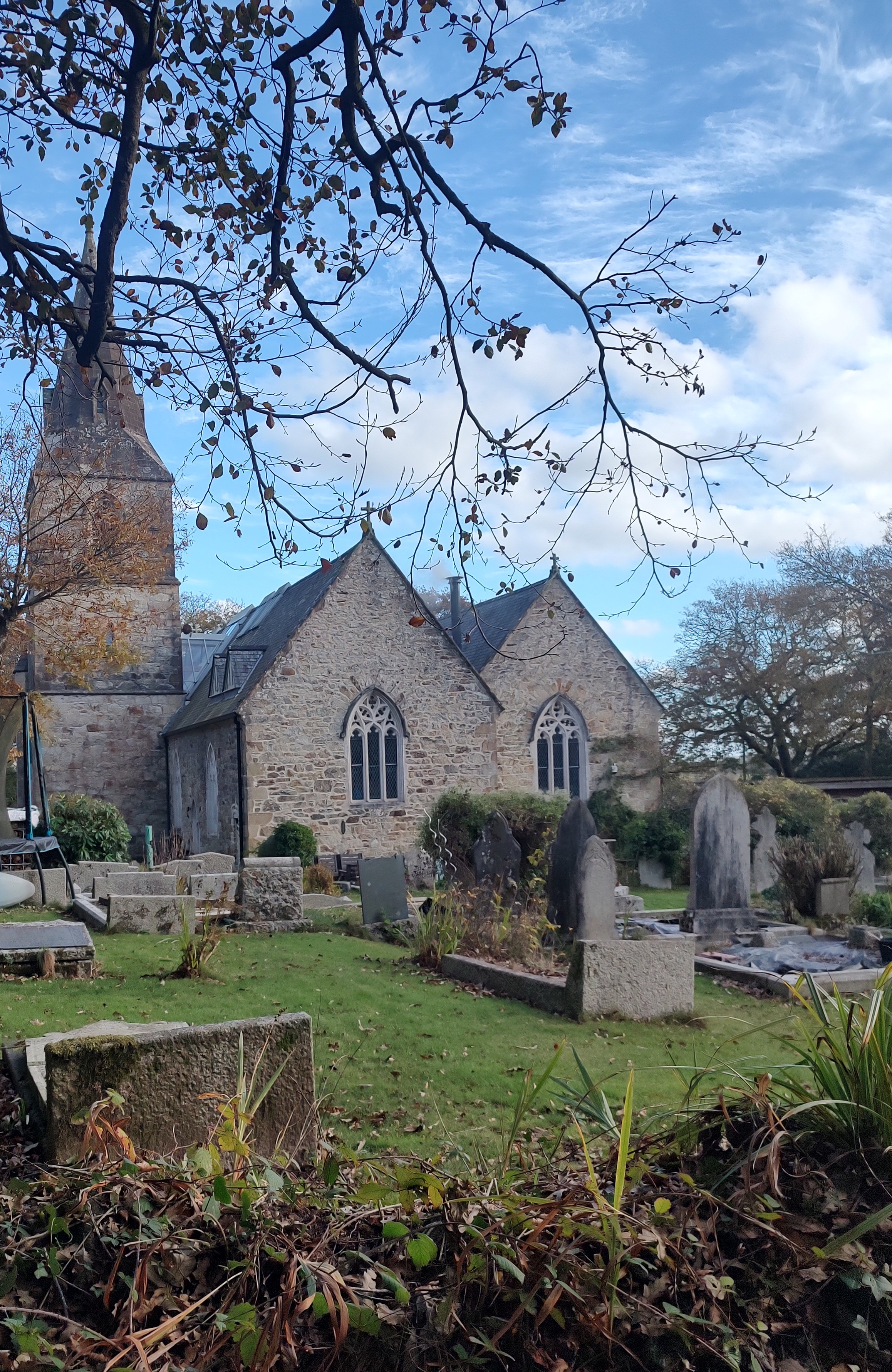
Now converted into luxury homes, Baldhu church was abandoned for decades until its restoration in 2009. During the 80’s – 00’s it was infamous for paranormal goings on, becoming the favourite place for local teenagers to seek supernatural thrills.
Boarded up Baldhu Church
Sat within dark encroaching woodland, uncannily the church itself faces south, a very rare feature, with churches normally facing east or west. This has inspired local lore telling how the church is somehow unholy; known as the ‘gateway to hell,’ or ‘satanic.’ For many years the church was boarded up, having finally shut its doors in the 1970’s, inviting intrepid teens and paranormal seekers to explore the graveyard and the eerie woodland, some even breaking into the church itself.
The lane cutting through Baldhu Woods leading to the church
The church and woodland became associated with dark rituals and paranormal activity. Witnesses tell tales of robed, hooded figures seen in the woodland chanting and conducting rituals. Some believe they saw stick figures and even bird’s feet hanging from trees. Others tell os satanic graffiti daubed inside the church. Wispy images of shadowed and ghostly figures have been captured in the woods and graveyard.
The church before the renovation
While the anecdotal history of the area is infamous, the recorded history is just as peculiar.
Two suspected bronze age barrows in Baldhu suggest the area has been occupied since prehistoric times. Goodern Manor on the edge of Baldhu is first recorded in the Domesday Book with a settlement of eight houses. The medieval field system was removed to make way for tin and copper mines in the 18th and 19th centuries. Mostly a Methodist area, the miners followed non-conformist faiths and the Viscount Falmouth, who owned the land and mines (and still does own most of the land,) was perturbed by the non-conformist faith of the miners and sought to convert the population back to the Church of England.
The Parish Church of St. Michael and All Angels in the 1800’s
To reassert the Anglican Church’s control over the population in 1848 he had a church built and named it The Parish Church of St. Michael and All Angels, now known locally as Baldhu Church (not be mistaken with Baldhu Methodist Chapel which still remains in use today.) With the Cornish apt to reject any anglicisation, the methodist faith was popular in Cornwall, especially among miners and their families. Ironically in its effort maintain its hold the Anglican church became the site of a religious conversion of one of its vicars to the revivalist faith. The Parson William Haslam experienced a spiritual awakening during one of his own sermons believing himself touched by the holy spirit, his cries of joy influenced many worshippers to fall to their knees and cry for mercy as they themselves felt the touch of the holy spirit. A significant event, this ignited a flame of religious fervour which spread across the county with Baldhu church at its epicentre.
Haslam’s Conversion
To the displeasure of the Anglican church and the Viscount many parishioners became born again, believing themselves touched by the holy spirit and would flock to the church with its aisles overflowing with worshippers after news of Haslam’s conversion spread. Unable to shake off its revivalist history, to this day an obelisk in the church grounds marks the spot of another local charismatic non-conformist preacher Billy Bray. Once a drunkard and a miner, he had a close shave with death and dedicated his life to God’s work building several methodist chapels in the area. Only one survives today at Kerley Downs, one mile from Baldhu.
It would seem Baldhu has been a centre of spirit activity through three centuries. Contradictions of light and dark, from bronze age monuments built to revere the dead, fevered revelations of the holy spirit, and folklore of something far darker from the other side.
The church and lane today. Sadly, the graveyard has not been treated with much respect, logs, play equipment and canoes are stored on top of graves by the occupants.
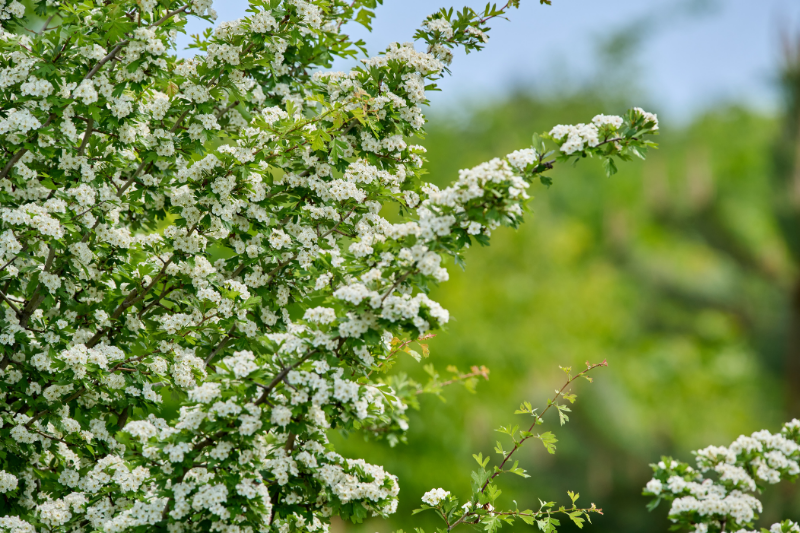
The May-Thorn blossom blooms heralding the changing of the seasons with it’s snowy clouds of petals. The unmistakable perfume of the hawthorn’s delicate white flowers brings the promise of summer on the fresh spring breeze.
This thorny shrub is often found in hedgerows or as small trees standing as lone sentinels in fields and rugged heathland where only the hardiest of flora survive. In Cornwall the impish hawthorn tree is often seen gnarled and twisted, perpetually wind-blown in the fierce Atlantic gales. Looming over the rural lanes from atop the Cornish hedgerows, or stood fast against the elements amongst gorse and heather.
As a seasonal signpost, the hawthorn announces spring with its blossom and greets autumn with its rusty red haws. Blossoming around May Day as the land quickens with life, the Hawthorn is celebrated in the folk customs of the British Isles for marking the birth of summer and the death of winter. For modern pagans the blooming of the hawthorn marks the arrival of Beltane, the Gaelic May Day festival.
May Day Celebrations in Cornwall Today
May-Day is still celebrated today in Cornwall. Obby oss in Padstow, Bolster in St. Agnes, Flora day in Helston, and in Penzance the revived custom of May-Horns. In the past the May-Day was a popular Cornish feast day, or ‘furry day’. Hawthorn blossom was a part of many May-Day folk customs, using the flowers as decoration.
Hawthorn has many names; May Tree, May Blossom, Quick Thorn and Whitethorn. In his book Fern Seed & Fairy Rings, Rupert White tells us how in Cornwall the hawthorn was often called May, Fryth or Aglet Tree. With the young edible shoots often called ‘bread and cheese.’
A tree traditionally sacred in the British Isles, the hawthorn is entrenched in folklore and rich with magical associations. In Celtic mythology the tree is associated with faeries, known to some as faerie-thorn, it marks a liminal space, a gateway to other worlds. It is also known to mark boundaries of sacred lands.
The hawthorn also has dark connotations. Often found standing alone, farmers avoided cutting them down for fear of angering the faeries. Throughout the British Isles it was also considered a dreadful omen of misfortune to bring any cuttings inside the house.
Rupert White tells us, in Cornish folklore it was said that to sit under a hawthorn in May is dangerous, in case you give the faeries power over you. There was also a superstition that young children sitting under the tree may be taken away by the fae.
Hawthorn has medicinal value and is renowned for improving heart health. The leaves, flowers and red berries (or haws), lower blood pressure and are high in vitamin C.
Pawton Quoit is a magnificent portal dolmen built by Cornwall’s stone age inhabitants. The imposing megalith sits, mostly intact, atop a ridge overlooking a steep valley.
Also known as Giant’s Quoit, the monument is found along the back lanes of Wadebridge, up a private farm track. The enormous capstone, which juts out incongruously against the landscape, must weigh at least 15 tonne, and perches on just three points of the supporting upright stones. Part of it has sheared off, and sits where it fell in front of the quoit’s façade. The dolmen sits on a raised earthen mound, perhaps the vestiges of a cairn that covered some or all of the monument.
In Cornwall we call dolmen quoits. A reference to the folk belief that Cornwall’s many megaliths were created by giants throwing stones at each other – quoit being a reference to the dolmen capstones resembling the discs thrown in a traditional game of quoits.
Cornwall’s quoits are thought to have been built in the early to mid-neolithic period. We can only wonder at the engineering skill, and size of the labour force required, to accomplish such a feat in the stone age. The society that built the quoit would have been organised, and have enough abundance to spare those workers from the business of farming food. Moving the huge capstone up the hill, and placing it on top of the uprights, would have been an extraordinary feat. The enormous size of it would have been impractical, and much larger than required to cap the chamber – it’s a statement.
The accomplishment of an immense engineering project like Pawton Quoit must have inferred status upon the community responsible. Portal dolmens would have been visually impressive, dominant markers in the landscape, looking over neolithic settlements and fields. Cornwall would have been mostly covered in dense temperate rain forest, except for small areas cleared for farming and settlement. Hilltops, like this one, would have been beacons rising out of the humid, wild tangle of forest, serving as places of safety and gathering.
Part of the capstone has sheared off and sits in front of the dolmen’s facade
In Cornwall quoits are often found overlooking valleys with a water source, or in places where neolithic settlements and fields have been found. These first farmers transformed the landscape for agriculture and permanent settlements. They were also the first megalithic builders, modifying their environment with monuments like Pawton.
Looking inside the quoit
The day of my visit the weather is wild, we are lashed by a squall of wind and rain blowing in off the North coast. In the early Neolithic period, the climate would have been warmer and drier than it is today. The hilltops, ridges and tor summits would have been more hospitable to settlement before the climate changed in the early bronze-age.
The original purpose of portal dolmen is unknown. It’s possible they were territorial, or used for burial and funerary rites. Although little human remains have been found, suggesting their primary purpose was something else. Given how architecturally impressive quoits like Pawton are, it seems they were meant to be seen. Were these marvels of prehistoric engineering built to meet the needs of the living, rather than those of the dead.
Lichen on the capstoneThe stones host an assortment of lichen
They could be cathedrals of spiritual significance, marking places considered sacred. Possibly for capturing earth energies, or marking the seasons through solar and astral alignments. Maybe the quoits were built to bring people together in ways we can’t imagine in our modern world that’s so disconnected from nature. Maybe these monuments were built for worshipping gods that have long been forgotten.
Or maybe, just maybe, the Cornish giants were real.
From Popular Romances of the West of England . Robert Hunt, 1865
A peculiar custom, once forgotten, Dolly dunking is a Cornish tradition where young girls would take their dolls to blessed in holy wells on Good Friday. A custom which has documented since the 1800’s.
In Cornish Feasts and Folklore (1890) M.A. Courtney recorded, “On the afternoons of Good Friday, little girls of Carharrack, in the parish of Gwennap, take their dolls to a stream at the foot of Carn Marth and christen them.” However, local anecdotes say this took place at Figgy Dowdy’s Well, also known as Margery Daw’s Well, located near the top of Carn Marth hill.
The same custom was observed at Fenton Bebibell sacred spring in west Penwith. (Cornish Homes and Customs, 1934) Named fenten byghan bobel in Cornish, which translates as “Well of the Little People,” this is a possible reference to the small people of Cornish folklore.
Cornish holy wells, and sacred springs, are thought to be places where spirits dwell, to whom offerings would be made for healing, blessings or foretelling. The custom of ‘dolly dunking’ could hark back to folk memories of ancestral spirits who dwelt in, or nearby, springs and the offerings people made to them.
Alternatively, the ‘little people’ could be a reference to the blessing and naming of babies, a practice that may have once taken place at holy wells. It’s possible these traditional rituals were being remembered and acted out by young girls with their dolls.
Good Friday doll blessing is a tradition that has been revived by CASPN at Fenton Bebibell in Morvah, which sits near the Men an Tol monument. The Cornish Ancient Sites Protection Network resurrected the custom 18 years ago and now do an annual ‘dolly dunk’ on Good Friday. The well was lost to the bracken and gorse of the heathland for decades until it was accidentally rediscovered in the 2000’s.
Is it possible that the tradition of dolly dunking, whatever its origins, was once widespread across Cornwall’s holy wells and springs. Taking place in isolated, insular communites, that weren’t in the habit of writing things down, the local customs were lost to time. Leaving us with only scant records of this peculiar Cornish tradition.