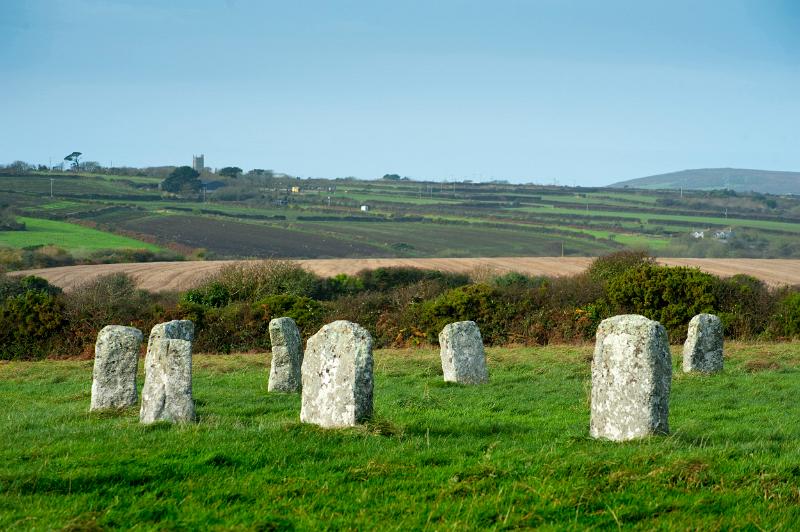
Cover Image: Merry maidens, Penwith. From photoeverywhere.co.uk
The Merry Maidens, one of Penwith’s four remaining stone circles, are a fine example of a Cornish megalithic monument. A perfect seventy-eight-foot circle, consisting of nineteen granite stones of around four foot in height.
Once named ‘Dans Maen’ – ‘Dance of Stones’ in Cornish, this is a probable reference to the monument’s adulterated Christian origin myth – maidens turned to stone for dancing on the Sabbath.
Often coined as ‘The Cathedrals of the Prehistoric,’ I find stone-circles the most atmospheric and magical of all megalithic sites. The most accepted dating for these monuments is from the early bronze age – 2500 – 1600 BC, although due to a lack of archaeological evidence they remain an enigma of prehistoric society.
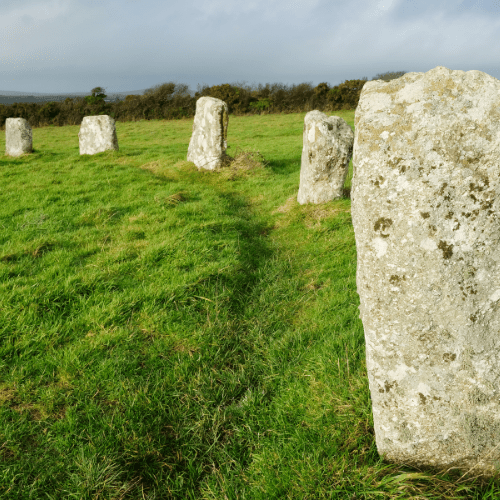
Could they be calendars of stone, wheels of time marking nature’s cycles, following celestial movements, harmonising with earth and cosmos. Or spaces for gatherings, festivals and rites of passage.
There are thought to have been around ten other stone circles in the Penwith district of Cornwall, most now lost or destroyed. The Merry Maidens monument itself had a twin circle, a few hundred metres to the east, also sadly destroyed by farmers.
The high quartz content of these granite menhirs could explain some of the unusual sensations, such as electric shocks reported by visitors to the monument, for quartz is known for its piezo-electric effect.
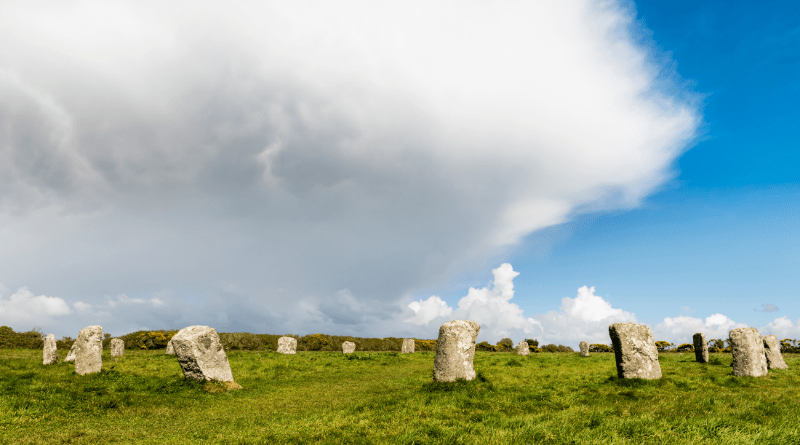
Sitting upon the North-facing slope of a hill, above a wooded valley, you can see the notable prehistoric sites of Chapel Carn Brea and Sancreed Beacon from the circle (Carn Galva on the north coast can be seen on a clear day,) suggesting its significance in the landscape.
This megalith was once part of a greater complex of bronze-age sites. Within half a mile stand the epic twin menhirs The Pipers, as well as four other bronze-age standing-stones, barrows and even a neolithic cairn. Maybe these sites are key nodes in a network of megalithic monuments which turned the wider landscape into a charged space.
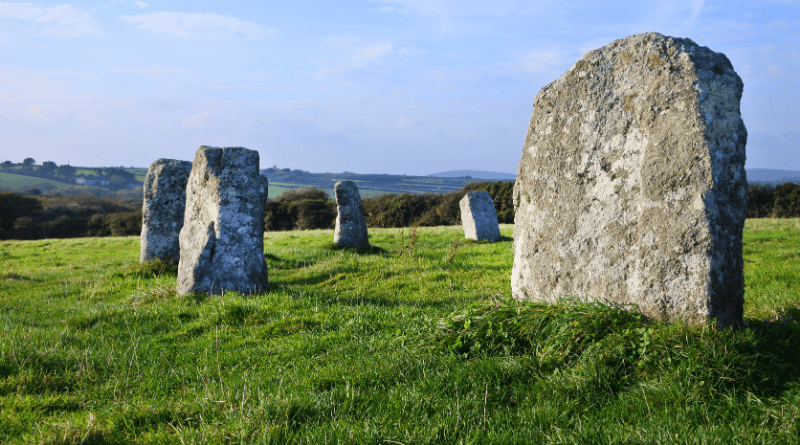
Some megalith pilgrims have reported peculiar goings on at the Merry Maidens, such anomalous lights and strange disembodied voices.
Large magnetic variations have been recorded, unusual electromagnetic phenomena that has been known to deflect compass readings. The stones themselves are flattened on the inside and curved on the outside of the circle, which could suggest the possibility that the circle itself acted as some kind of resonator or amplifier.
These are all curious theories that fire the imagination.
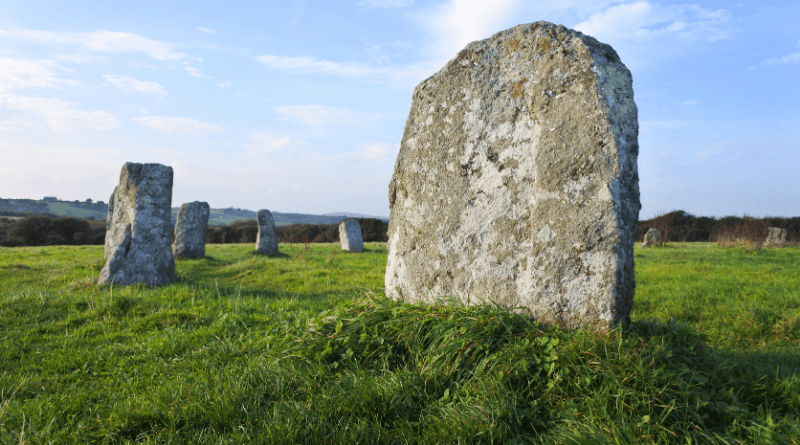
The neolithic inhabitants of this land were the first to make their mark, the first to adorn and shape the landscape to their liking. Here in the southern half of the Penwith district this process seems to have started with Tregiffian barrow (the chambered cairn that sits just south of the Merry Maidens) and continued through the latter half of the bronze-age, with standing menhirs, holed stones and of course the stone circles.
In the wooded valley below, in Boleigh, there is evidence of an iron-age settlement and a fine intact example of the uniquely Cornish iron-age fogou.
Is it possible the Merry Maidens were the crowning glory of a sacred landscape revered over millennia?
First Published in Ancient Times: Vol. 1
Share your experiences with the Merry Maidens comment below
Follow me on BlueSky
 Uncanny Cornwall Blog
Leave a comment